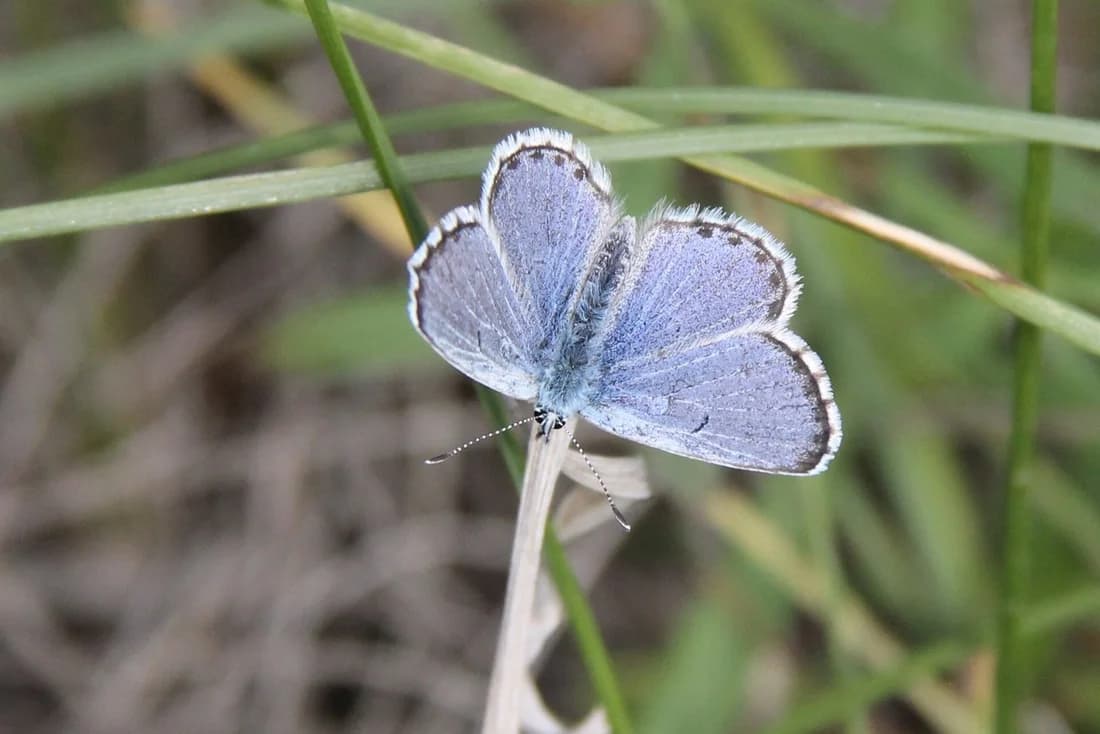
The eastern baton blue is a small blue butterfly with chequered black and white fringes, bright blue males and brown females. It lives from central and eastern Europe through Turkey and Central Asia to western China.
Dry, warm, open sandy or gravelly ground with thyme, such as sunny south-facing slopes, sandy banks, river gravel, sand pits and other disturbed ground, and mountain meadows.
Identifying features
Wingspan 19–29 mm. The male's upper side is bright grey-blue with a dark border and black marginal dots on the hindwing; the female is brown with some blue at the base. The wing fringes are chequered black and white. The underside is grey to brownish-grey, bluish at the base, with black spots that are only weakly edged in white; the hindwing has orange patches along the margin and no blue.
Similar species
The silver-studded blue (Plebejus argus) has evenly white fringes and blue in the row of marginal spots on the hindwing underside. The chequered blue (Scolitantides orion) is larger and darker overall. The baton blue (Pseudophilotes baton) is extremely similar and differs mainly in the genitalia.
Biology
The caterpillars feed only on wild thyme (Thymus serpyllum) and live in association with ants. They overwinter half-grown and pupate near the ground in late spring. The adults fly from late May to July.
Facts by country
The description above applies everywhere. Status, flight period and distribution apply only to the selected country.
In Finland
Status in this countryVery rare resident in FinlandCR (Critically endangered)33 recorded sightings
Records per month
JJanuary: 0
FFebruary: 0
MMarch: 0
AApril: 0
MMay: 4
JJune: 28
JJuly: 1
AAugust: 0
SSeptember: 0
OOctober: 0
NNovember: 0
DDecember: 0
Recorded sightings in Finland by month of the year.
Flight period
On the wing from late May to late July. The larva overwinters half-grown.
Distribution
Very rare. It formerly occurred locally on many eskers in southern and central Finland but disappeared from most sites in the 1970s and 1980s. The main population is at Säkylä, and a population was found at Alastaro in 2013.

 Finland