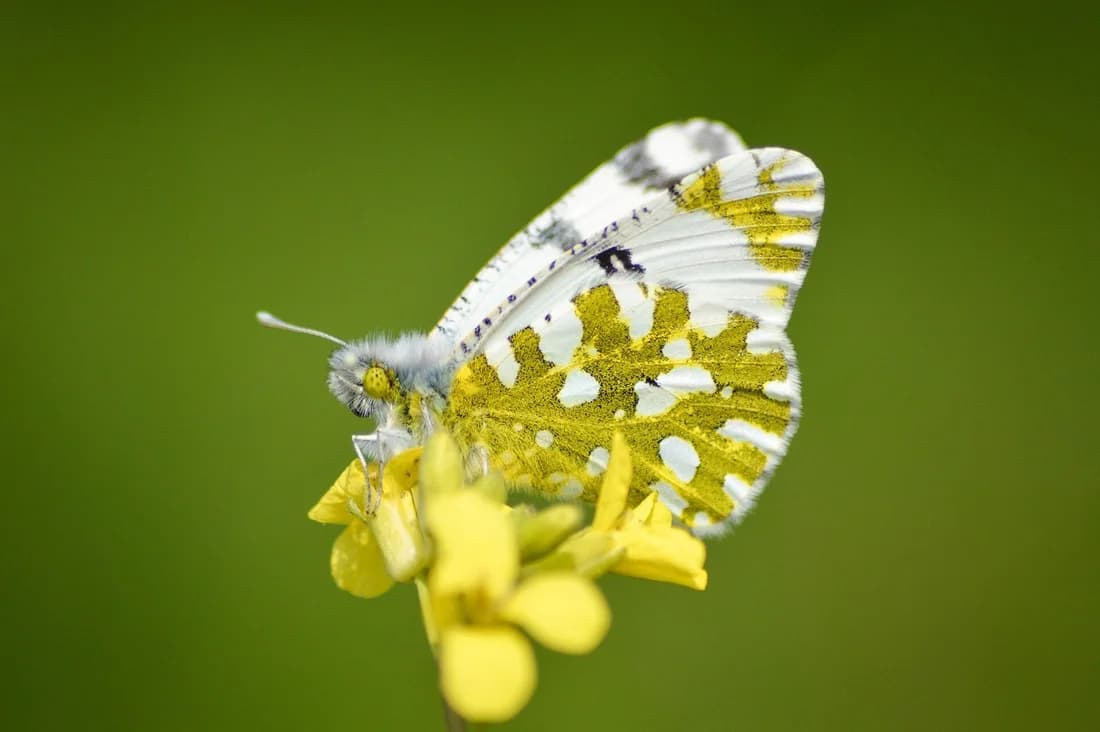
The eastern dappled white is a white butterfly with dark forewing tips and a yellow-green marbled hindwing underside. It occurs from south-eastern Europe through the Middle East to Central Asia.
Rocky slopes and meadows, sunny dry grassland, disturbed or abandoned land, open olive groves, roadsides, mountain meadows and woodland edges, up to about 2000 m.
Identifying features
Wingspan 36–48 mm. The upper side is white with a dark, white-spotted forewing tip and a black spot at the end of the cell that does not reach the front edge. The hindwing underside is the best field mark: it is marbled with yellow-green and white patches. The female is generally darker, the two generations differ somewhat in pattern, and the forewing tip is pointed.
Similar species
The western dappled white (Euchloe crameri) looks almost identical but has a separate range. The bath whites, such as the Eastern Bath White (Pontia edusa), have longer, thinner antennae.
Biology
The caterpillars feed on the flowers and young seed pods of crucifers (Brassicaceae) such as charlock (Sinapis arvensis) and woad (Isatis tinctoria). They are yellowish to greenish with pale side stripes. There are one or two generations a year, flying from March to July, and the pupa overwinters.
Facts by country
The description above applies everywhere. Status, flight period and distribution apply only to the selected country.
In Finland
Status in this countryVagrant in FinlandNA (Not applicable)
Flight period
Abroad it flies from March to July in one to two generations. Overwinters as a pupa.
Distribution
Recorded only once in Finland: a single butterfly in Helsinki in 1970 (during a large influx of Pontia edusa from Russia), found only in 2009 in the collection of a deceased collector.

 Finland