
 Ireland
Identifying features
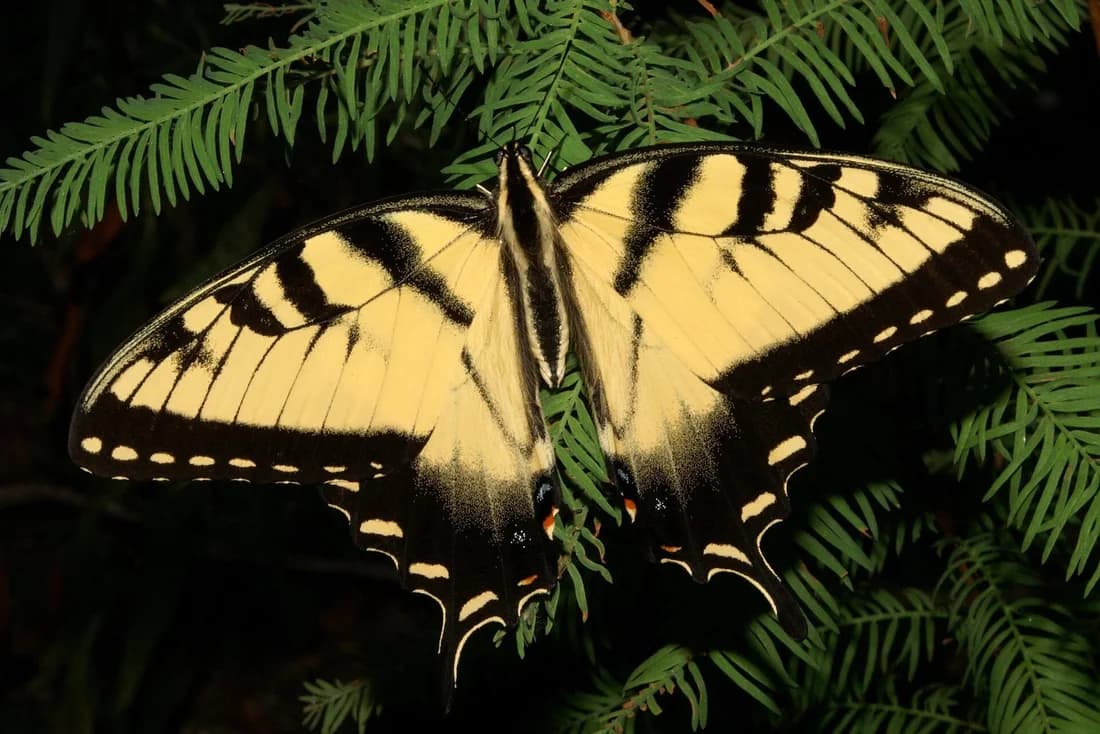
Wingspan about 62–140 mm; the female is larger, and southern individuals are larger than northern ones. The male is yellow with four black tiger stripes on each forewing, a black outer edge with a row of yellow spots, and black veins. The hindwing has a black outer zone with yellow marginal spots and small red and blue spots at the inner margin. Females occur in a yellow form, like the male but with blue on the hindwing, and in a dark, almost black form. A broken yellow bar along the forewing underside edge separates it from close relatives.
Similar species
The Canadian Tiger Swallowtail (Papilio canadensis) is very similar. The dark female can be mistaken for the Pipevine Swallowtail (Battus philenor), the Spicebush Swallowtail (Papilio troilus) or the female Black Swallowtail (Papilio polyxenes); the Spicebush Swallowtail is greener and has two rows of orange spots on the hindwing underside.
Biology
The caterpillars feed on many trees, especially tulip tree (Liriodendron tulipifera), sweetbay magnolia (Magnolia virginiana) and wild black cherry (Prunus serotina), and also ash (Fraxinus). Young caterpillars are brown with a white saddle and look like bird droppings; later they are green with a swollen thorax bearing two large false eyespots. The chrysalis overwinters. There are one or two generations in the north and up to three in the south.