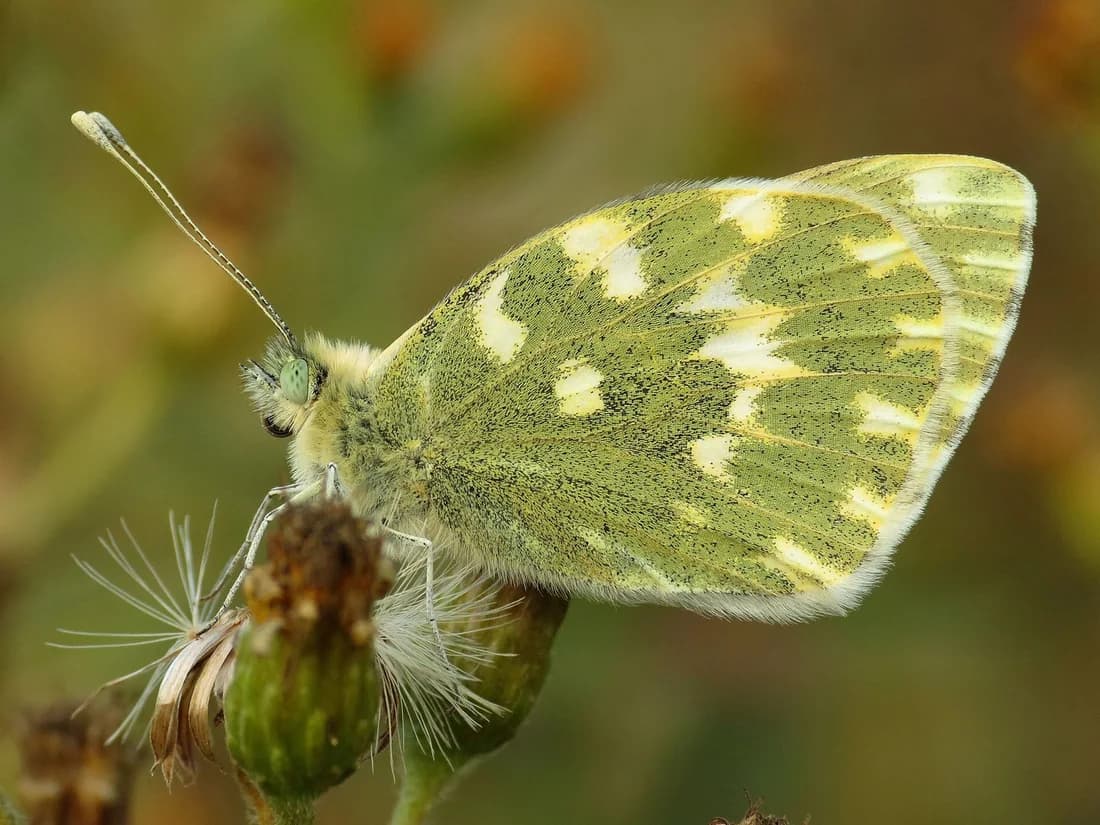
The Bath White is a small white butterfly with a dark, white-spotted forewing tip and a hindwing underside marbled with olive-green patches. It is common in southern Europe and migrates northwards in summer.
Open, flowery grassland and meadows, dry slopes, rough ground with little vegetation, coastal dunes, wayside verges, gardens and parks, up to about 2700 m.
Identifying features
Wingspan 45–52 mm. The upper side is white with a grey-black forewing tip carrying white spots and a large, almost square black spot at the end of the cell; the hindwing has a few dark spots along the edge. The underside is the best field mark: the hindwing is marbled with olive-green patches broken by white, and the forewing tip is greenish. The female is usually larger and more heavily marked, with an extra spot on the forewing and a faint row of dark spots along the hindwing margin.
Similar species
The Eastern Bath White (Pontia edusa) looks identical and can be told apart only by examining the genitalia. In the Lofty Bath White (Pontia callidice) the green marbling follows the veins. The Orange-tip has a similar marbled underside, but it is far more broken up.
Biology
The caterpillars feed on crucifers such as tower mustard (Turritis glabra) and sea rocket (Cakile maritima) and on mignonettes (Reseda). They are slim, green to blue-grey with yellow stripes on the back and sides and rows of black dots, and grow to about 30 mm. There are several generations a year. Autumn pupae overwinter but survive only in mild climates. Adults are strong, fast fliers and migrate widely.
Facts by country
The description above applies everywhere. Status, flight period and distribution apply only to the selected country.
Status in this countryRare migrant to the UK; fewer than 20 records since 1952NA (Not applicable)
Flight period
Typically seen in the UK in July, August and September. It is believed unable to survive the British winter.
Distribution
An extremely scarce immigrant that in some years is not seen at all. There was a great immigration in 1944–1950, with over 700 seen in 1945, mostly in Cornwall; fewer than 20 individuals have been recorded since 1952.
In Ireland
Status in this countryVagrant in Ireland; never establishedNA (Not applicable)
Flight period
No regular flight period in Ireland, as the species does not breed there.
Distribution
Listed as a vagrant that has never become established in Ireland.

 United Kingdom
 Ireland