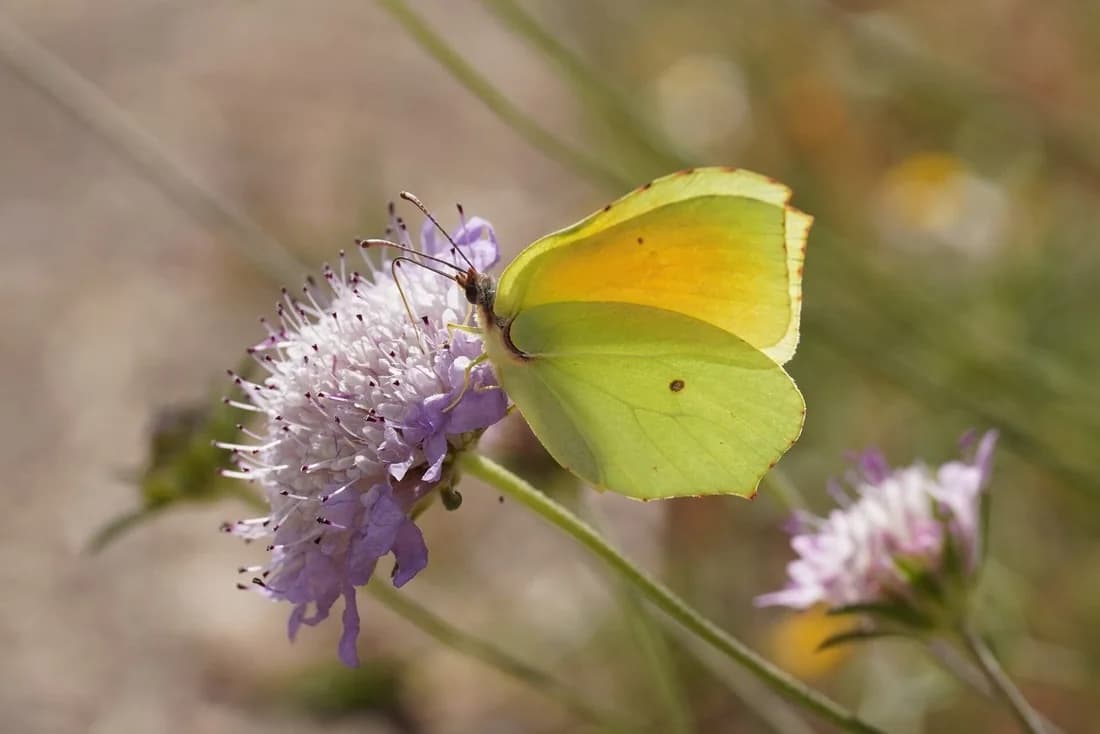
The Cleopatra is a large, leaf-shaped yellow butterfly with a hooked forewing tip. The male is deep yellow with an orange-red patch on each forewing, the female pale greenish white. It is a Mediterranean species.
Open woodland and scrub and bushy, rocky open ground with flowers; often patrols woodland edges and hedges. From the lowlands up to about 1600 m.
Identifying features
Wingspan about 50–74 mm. The male is deep yellow with a large orange-red patch on the upper forewing; the female is pale yellow to greenish white without the orange. Both sexes have a hooked forewing tip and a small brown to orange spot in the centre of each wing. The underside is pale greenish yellow with prominent veins, and with closed wings the butterfly looks like a leaf. The wing shape is rounder and fuller than in the Brimstone.
Similar species
The Brimstone (Gonepteryx rhamni) is very similar, but its male has no orange on the forewing and the wing shape is less rounded. Females are harder to separate; the Cleopatra has a fuller, more outward-curved wing outline and a more whitish-green ground colour.
Biology
The caterpillars feed on buckthorns (Rhamnus), such as Mediterranean buckthorn (Rhamnus alaternus) and purging buckthorn (Rhamnus cathartica), and on alder buckthorn (Frangula alnus). The green caterpillar is stouter and bluer than the Brimstone's. The pupa hangs in a silk girdle under a leaf, green at first, then yellow and red. Adults overwinter in evergreen trees and shrubs. There is mostly one generation a year, flying from May or June. In dry regions it moves to higher ground in summer.
Facts by country
The description above applies everywhere. Status, flight period and distribution apply only to the selected country.
In the United Kingdom
Status in this countryVagrant: several UK records over 150 yearsNA (Not applicable)1 recorded sightings
Records per month
JJanuary: 0
FFebruary: 0
MMarch: 0
AApril: 0
MMay: 0
JJune: 0
JJuly: 0
AAugust: 0
SSeptember: 1
OOctober: 0
NNovember: 0
DDecember: 0
Recorded sightings in the United Kingdom by month of the year.
Flight period
No UK flight period is given in the sources consulted; the species is known in the UK only from occasional records.
Distribution
Not found in the UK as a resident. There have been several UK records over the past 150 years, but the species is not considered migratory and its presence has been attributed to passage by ship. Its range is southern Europe north to southern France and North Africa.

 United Kingdom