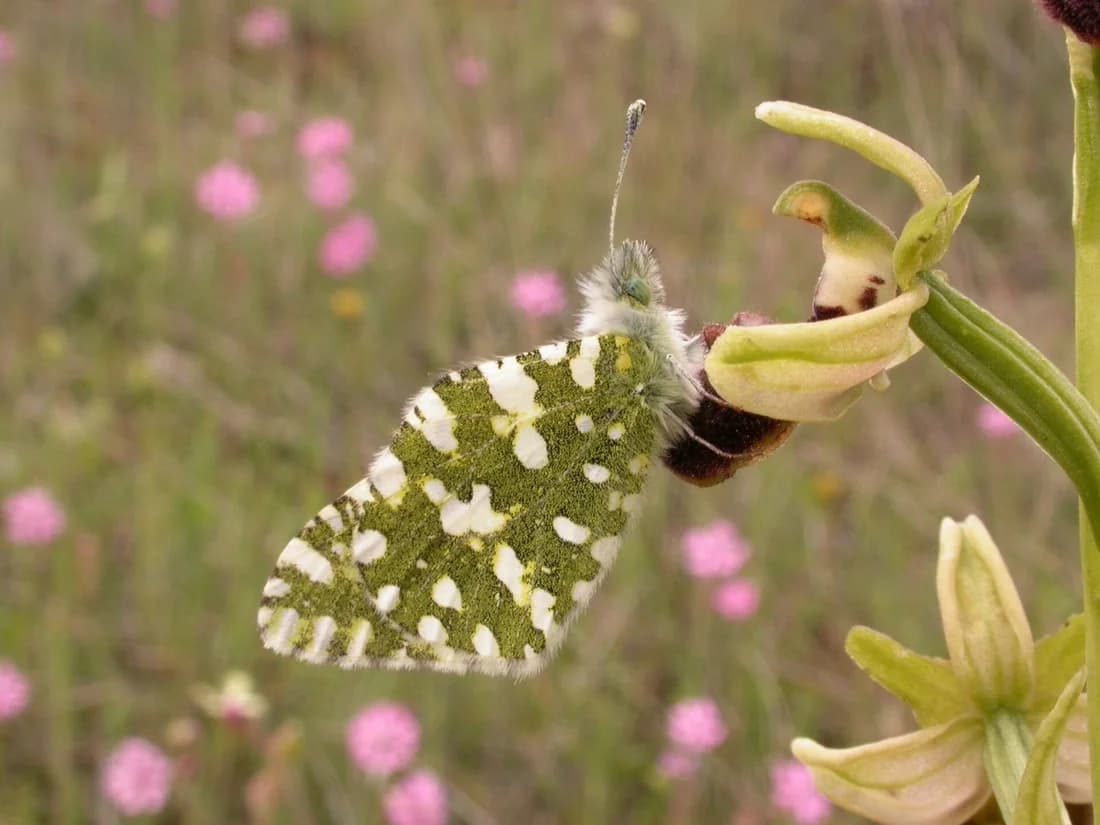
The Western Dappled White is a medium-sized, mostly white butterfly with a black, white-speckled forewing tip and a hindwing underside marbled in grey-green, yellowish and white. It lives in south-western Europe and North Africa.
Dry, warm, flowery open land: dry meadows, rocky steppe, woodland edges, neglected farmland, open olive groves and roadsides, locally also slightly damper meadows. In the mountains up to about 2000 m.
Identifying features
The upper side is pearly white with a dark grey central spot and a broad black forewing tip speckled with white. The forewing underside is similar, but the tip is greenish yellow. The hindwing underside is marbled in grey-green, yellowish and white. The female is larger and more greenish, because black and yellow scales overlie each other. The leading edge of the hindwing has a distinct kink, and the outer margin of the forewing is slightly concave.
Similar species
The Eastern Dappled White (Euchloe ausonia) and Euchloe simplonia are very similar and can often be separated only by range and altitude; in Euchloe simplonia the black spot on the forewing is narrower and often reaches the margin. Iberochloe tagis is usually smaller, with a rounder hindwing corner and a smoothly curved hindwing leading edge without the kink.
Biology
Eggs are laid singly on the buds of crucifers such as buckler mustards (Biscutella), dyer's woad (Isatis tinctoria), wild radish (Raphanus raphanistrum) and charlock (Sinapis arvensis). The caterpillar eats flowers and young fruits; it is greyish to yellowish green with yellow stripes and tiny black dots. There are usually two generations, flying from March to June; high in the mountains there is only one, in June–July. The pupa overwinters and may lie over for a year or more.
Facts by country
The description above applies everywhere. Status, flight period and distribution apply only to the selected country.
In the United Kingdom
Status in this countryVagrant: only four UK recordsNA (Not applicable)
Flight period
No UK flight period is given in the sources consulted; the species is known in the UK only from occasional records.
Distribution
Only four specimens have been seen in the British Isles: two males caught at Dover in August 1887, considered doubtfully genuine, and two caught near Warwick on 9 May 1948. These may have been imported accidentally with animal foodstuff or seeds.

 United Kingdom