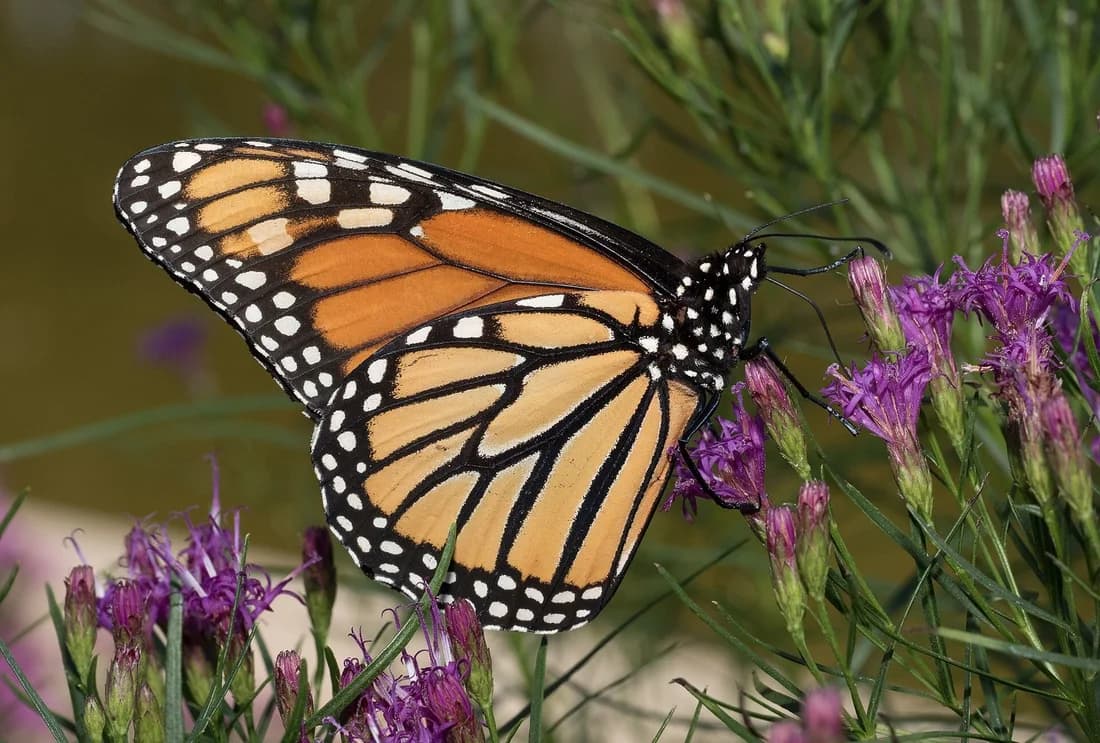
The Monarch is a large, tawny-orange butterfly with black veins and a black border dotted with white spots. A North American species famed for its long migrations, it reaches Europe only as a rare vagrant.
Almost anywhere its milkweed host plants grow, including farmland, gardens and roadsides; overwinters in sheltered forest.
Identifying features
Wingspan 89–102 mm. The upper side is tawny orange with black veins and a broad black border carrying two rows of small white spots; the forewing tip has a few orange spots. The underside is similar, but the wing tips are yellow-brown. The male has a small black scent spot on a vein of each hindwing and thinner veins; the female is darker, with thicker black veins.
Similar species
In North America the Viceroy (Limenitis archippus) looks similar but is markedly smaller and has an extra black stripe across each hindwing.
Biology
The caterpillars feed only on milkweeds (Asclepias), such as common milkweed (Asclepias syriaca), and store their toxins, which make the butterfly distasteful. The caterpillar is banded in white, yellow and black, and the pale green chrysalis has golden dots. A butterfly can develop from egg to adult in as little as 25 days in warm weather. North American populations migrate thousands of kilometres south in autumn and return over several generations in spring. Strong fliers sometimes cross the Atlantic.
Facts by country
The description above applies everywhere. Status, flight period and distribution apply only to the selected country.
Status in this countryVagrant: a very rare immigrant, fewer than 500 recordsNA (Not applicable)23 recorded sightings
Records per month
JJanuary: 0
FFebruary: 0
MMarch: 0
AApril: 0
MMay: 0
JJune: 3
JJuly: 5
AAugust: 6
SSeptember: 3
OOctober: 6
NNovember: 0
DDecember: 0
Recorded sightings in the United Kingdom by month of the year.
Flight period
Sightings have been recorded from March to November, with a peak in September and October. It cannot survive the British winter.
Distribution
The largest butterfly seen in the British Isles and one of the rarest migrants, recorded throughout Britain and Northern Ireland with a concentration of sightings in the south-west, notably Cornwall and the Isles of Scilly. First recorded in 1876 at Neath, south Wales; the total for the British Isles is under 500 records, including about 40 individuals caught in 1933.

 United Kingdom
 Ireland