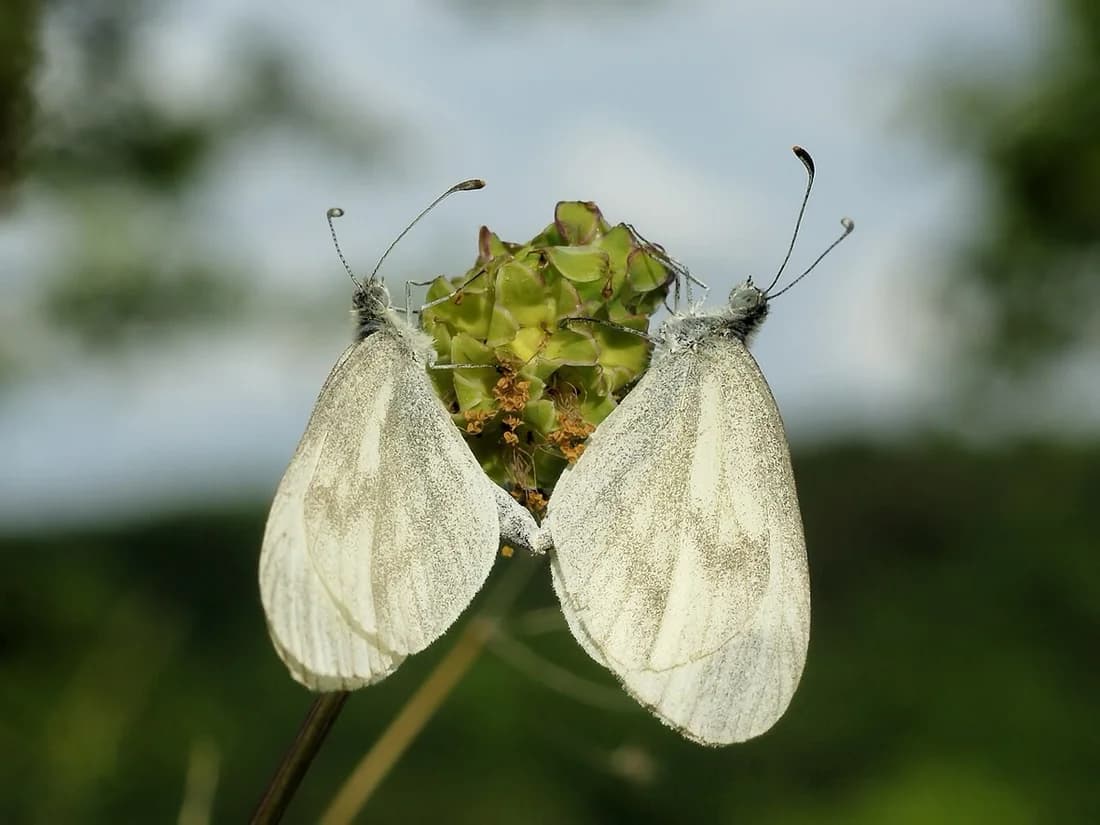
The Wood White and the Cryptic Wood White are two small, delicate white butterflies with narrow, drop-shaped wings, a grey spot at the male's forewing tip and a slow, fluttering flight. They cannot be told apart reliably from photographs.
Woodland clearings, tracks and edges, warm bushy fringes and lean meadows (mostly the Wood White); more open meadows, pastures, fringes and fallow land with tall herbs (mostly the Cryptic Wood White).
Identifying features
Wingspan 36–44 mm. The wings are white, rounded and drop-shaped, and the abdomen is very slender and fairly long. Males have a pale grey to black-grey spot at the forewing tip; in females it is smaller and paler, reduced to grey dusting along the veins, or absent. The underside is white to greenish yellow with blurred darker markings. The antennal club is black with a brown tip and a white spot. They almost always sit with closed wings. In spring males the tip spot differs only statistically: larger and evenly grey in the Wood White, sharper, more black-dusted and often drawn towards the base along the leading edge in the Cryptic Wood White.
Similar species
The two species look the same and cannot be separated reliably from photographs; this takes examination of the genitalia or DNA. Habitat gives a hint: the Wood White prefers woodland clearings, the Cryptic Wood White more open meadows.
Biology
The green caterpillars have a pale side line, cannot be told apart and feed on legumes such as meadow vetchling (Lathyrus pratensis), tufted vetch (Vicia cracca) and bird's-foot trefoil (Lotus corniculatus); the Wood White also uses bitter vetch (Lathyrus linifolius) and medicks (Medicago). Both overwinter as a girdled pupa on a stem. There are one or two generations a year. The flight is weak and fluttering, close above the vegetation, and populations are usually small.
Facts by country
The description above applies everywhere. Status, flight period and distribution apply only to the selected country.
Status in this countryWood White: declining resident in England and Wales; Cryptic Wood White: resident in Northern Ireland onlyWood White: EN (Endangered); Cryptic Wood White: not assessed in the GB list (occurs in Northern Ireland only)9,989 recorded sightings
Records per month
JJanuary: 0
FFebruary: 0
MMarch: 0
AApril: 57
MMay: 3,219
JJune: 3,271
JJuly: 2,190
AAugust: 1,217
SSeptember: 35
OOctober: 0
NNovember: 0
DDecember: 0
Recorded sightings in the United Kingdom by month of the year.
Flight period
Wood White: early May–June in England, with a second generation at some sites, especially in Surrey and Sussex. Cryptic Wood White: May–June, with no evidence of a second generation. Overwinters as a pupa.
Distribution
Wood White: once found across much of southern England and into eastern Wales, it has declined rapidly; its strongholds are now the woods of the West Midlands and Northamptonshire and the coastline of East Devon. Cryptic Wood White: in the UK found only in Northern Ireland. The two species look identical. Distribution trend of the Wood White −76% (1992–2019), abundance trend −82% (1979–2019).
Status in this countryWidespread but local resident in IrelandNT (Near threatened) / LC (Least concern)33 recorded sightings
Records per month
JJanuary: 0
FFebruary: 0
MMarch: 0
AApril: 1
MMay: 21
JJune: 9
JJuly: 0
AAugust: 2
SSeptember: 0
OOctober: 0
NNovember: 0
DDecember: 0
Recorded sightings in Ireland by month of the year.
Flight period
April–July in one generation; an occasional second generation has been recorded in the Burren in late July and early August. The pupa overwinters.
Distribution
Two look-alike species that cannot be told apart in the field. Cryptic Wood White (Leptidea juvernica), the commoner, occurs in all regions; Wood White (Leptidea sinapis) is confined to the eastern Burren and the limestone west of Lough Corrib.
Status in this countryCommon resident in FinlandLC (Least concern)10,884 recorded sightings
Records per month
JJanuary: 0
FFebruary: 0
MMarch: 0
AApril: 18
MMay: 3,175
JJune: 5,192
JJuly: 1,859
AAugust: 612
SSeptember: 27
OOctober: 1
NNovember: 0
DDecember: 0
Recorded sightings in Finland by month of the year.
Flight period
On the wing from mid-May to early July. A second generation flies in July–August. In Leptidea juvernica the first generation flies until the end of June; in Leptidea sinapis the second generation is rare. Overwinters as a pupa.
Distribution
Leptidea sinapis occurs throughout the country but only occasionally in Lapland; in southern Finland it is common but usually seen singly. Leptidea juvernica is recorded in 13 of Finland's 21 biogeographical provinces.

 United Kingdom
 Ireland
 Finland