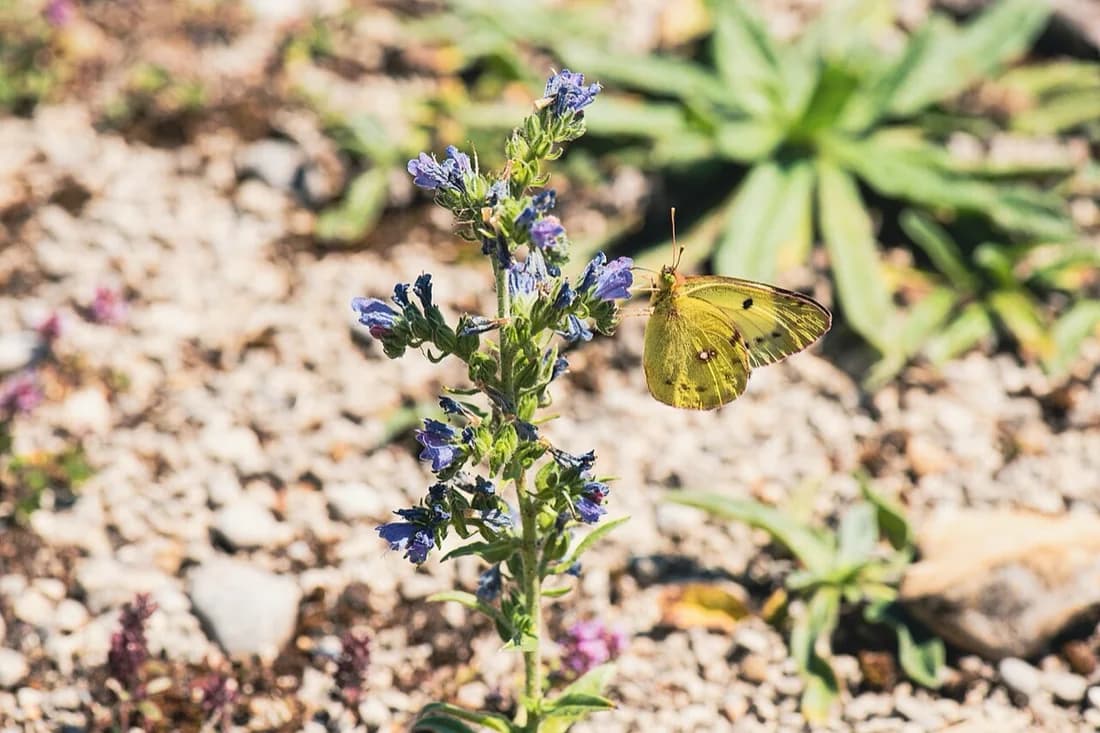
The Pale Clouded Yellow and Berger's Clouded Yellow are two almost identical pale yellow butterflies with a dark forewing border and an orange spot on the hindwing; females are yellowish to greenish white. Adults cannot be reliably told apart from photographs.
Warm, dry, flowery open land: clover and lucerne fields, pastures, fallow land and dry grassland (the Pale also gravel pits, railway yards and verges); Berger's prefers calcareous dry grassland and dry scrub or woodland edges with horseshoe vetch and avoids cool, rainy areas.
Identifying features
Wingspan about 35–62 mm. The male is pale lemon yellow, the female yellowish to greenish white. The forewing has a dusted dark brown to black border above, narrow on the hindwing and sometimes almost absent, and a black spot at the end of the cell above and below. The hindwing has an orange cell spot, which on the underside is pale-centred, ringed red and often split in two like a figure eight. Berger's tends to have rounder wings and run-together yellow spots in the dark border, the Pale separate yellow spots in the outer part of the border, but these differences are subtle and unreliable.
Similar species
Adults of the two species cannot be separated reliably, either by appearance or by genitalia; only the caterpillars differ clearly. Host plants and habitat give a hint. The Clouded Yellow (Colias croceus) is deep orange, and its male has no yellow spots in the dark border.
Biology
The Pale's caterpillar is green with two thin greenish-yellow side lines and orange-brown dashes and feeds on clovers such as white clover (Trifolium repens), also bird's-foot trefoil (Lotus corniculatus), lucerne (Medicago sativa), crown vetch (Securigera varia) and vetches (Vicia). Berger's has four conspicuous yellow lines with black dots and feeds only on horseshoe vetch (Hippocrepis comosa) and crown vetch. Both overwinter as caterpillars and have several generations; the Pale is a strong migrant that spreads north through summer.
Facts by country
The description above applies everywhere. Status, flight period and distribution apply only to the selected country.
Status in this countryPale Clouded Yellow and Berger's Clouded Yellow: rare migrants to the UKPale Clouded Yellow: NA (Not applicable); Berger's Clouded Yellow: NA (Not applicable)2 recorded sightings
Records per month
JJanuary: 0
FFebruary: 0
MMarch: 0
AApril: 0
MMay: 0
JJune: 0
JJuly: 1
AAugust: 1
SSeptember: 0
OOctober: 0
NNovember: 0
DDecember: 0
Recorded sightings in the United Kingdom by month of the year.
Flight period
May or June to early September, normally seen in August or early September. Early migrants breed, so later individuals are a mix of their offspring and new immigrants; up to three generations in good years. It appears unable to survive the British winter.
Distribution
Both are extremely rare immigrants, now among the rarest UK migrants. Colias hyale: 8,500 records between 1826 and 1950, mainly in southern England, but as far north as Cumbria and the Inner Hebrides (1947). Colias alfacariensis: about 50 historic specimens, mostly from the south coast of England, especially Kent; earliest taken at Folkestone in 1875.
In Ireland
Status in this countryVagrant: very few Irish recordsNA (Not applicable)
Flight period
No regular flight period in Ireland, as neither species is resident there.
Distribution
Rare vagrants that have never become established. Ireland's National Biodiversity Data Centre (NBDC) holds only 2 Irish records of Pale Clouded Yellow.

 United Kingdom
 Ireland
 Finland