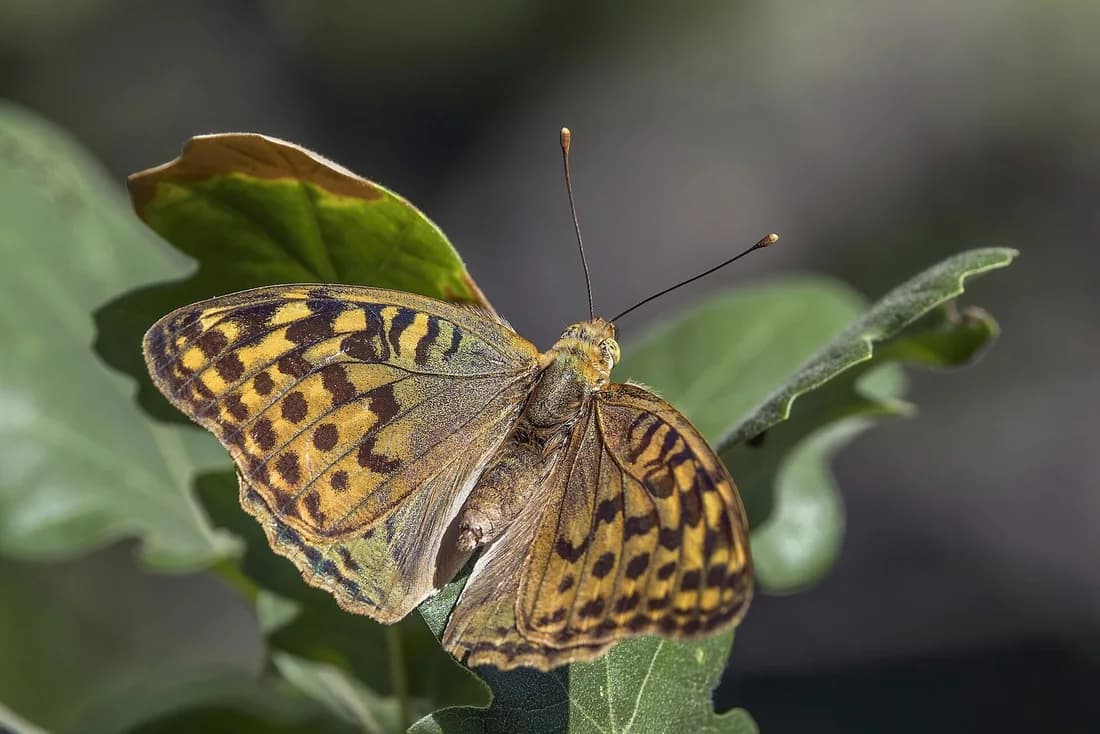
The Cardinal is a very large, orange fritillary with black spots and a greenish shimmer on the hindwing, and a green underside with silver bands and a pink-red patch on the forewing. It lives in southern and central Europe, North Africa and east to western Asia.
Deciduous woodland and open pine woods with sunny clearings and bushy edges rich in thistles, knapweeds and other nectar plants, from the lowlands up to about 2600 m.
Identifying features
Wingspan 64–84 mm. The upper side is orange with black spots and a faint greenish shimmer on the hindwing; some females are brownish instead of orange. The forewing underside has a striking pink-red or orange patch, and the hindwing underside is matt green with silvery bands, clear in the female and faint in the male. The female is larger than the male.
Similar species
The Silver-washed Fritillary (Argynnis paphia) is similar but paler and less green; the Cardinal is told apart by the different course of the silver bands, the pink-red or orange patch on the forewing underside and the matt green hindwing.
Biology
The caterpillars feed on violets (Viola), especially wild pansy (Viola tricolor). The dark caterpillar has orange stripes and spines. Eggs are laid on withered plants and the young caterpillar overwinters. There is one generation a year over most of Europe, flying from May into summer. Adults fly fast and gracefully and visit thistles and knapweeds.
Facts by country
The description above applies everywhere. Status, flight period and distribution apply only to the selected country.
In the United Kingdom
Status in this countryVagrant: two UK records (1911 and 1969)NA (Not applicable)
Flight period
The two UK records are from August (1911 and 1969). No UK flight period is given in the sources consulted.
Distribution
Only two sightings have been recorded: a female in a valley near Tintagel, east Cornwall, in August 1911, and a female at Durdle Door, Lulworth, Dorset, on 13 August 1969. It is a very rare immigrant that is undoubtedly mistaken for the Silver-washed Fritillary and therefore under-recorded.

 United Kingdom