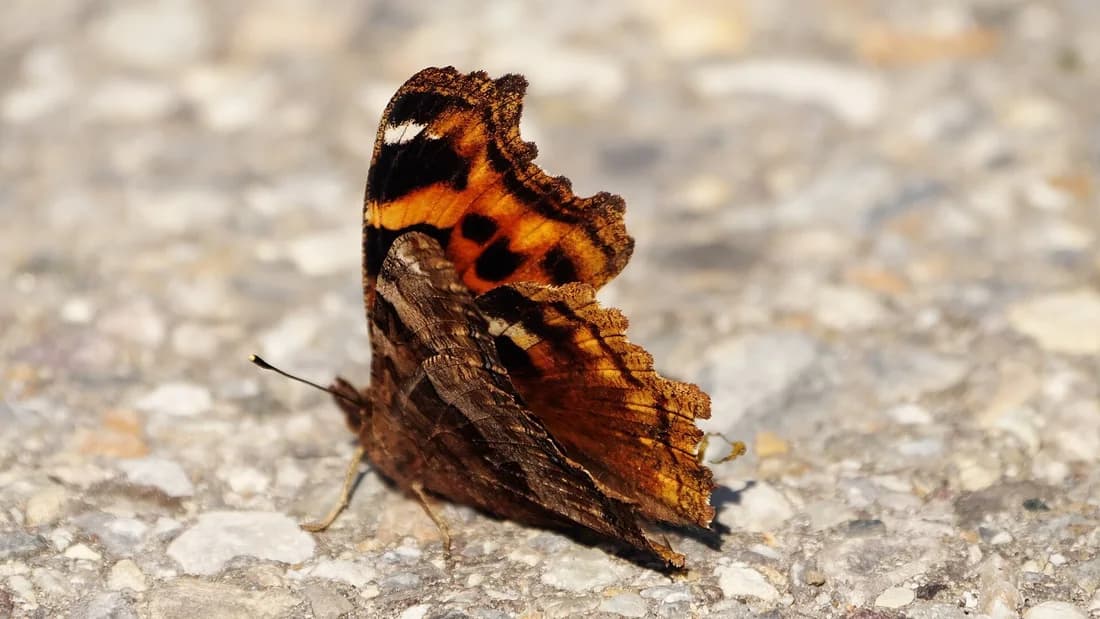
The Compton tortoiseshell is a large orange-brown tortoiseshell with ragged wings, a white spot on the front edge of each wing and a small white L or V on the hindwing underside. It lives from eastern Europe across Asia to Japan and in North America.
Deciduous and coniferous forest, especially forest edges and river banks.
Identifying features
Wingspan 50–78 mm. The upper side is orange-brown with darker wing bases, black spots and strongly toothed wing edges. There is a clear white spot near the forewing tip and a large white spot at the middle of the front edge of the hindwing; the hindwing margin has no blue spots. The underside is mottled grey, brown and black, with a small white L- or V-shaped mark on the hindwing, which is most prominent in males.
Similar species
The large tortoiseshell (Nymphalis polychloros), the yellow-legged tortoiseshell (Nymphalis xanthomelas) and the small tortoiseshell (Aglais urticae) lack the white spot on the hindwing and the white mark underneath. The comma (Polygonia c-album) shares the white mark on the underside, which is why this species is also called the false comma.
Biology
The female lays her eggs in a clump on the host plants, which are aspen (Populus tremula), willows (Salix) and elms (Ulmus), and the caterpillars feed together until they pupate. There is one generation a year; the adults overwinter and fly again in spring. They rest on sunlit tree trunks, come to sap and rotting fruit, and in some years migrate far beyond their normal range.
Facts by country
The description above applies everywhere. Status, flight period and distribution apply only to the selected country.
In Finland
Status in this countryVagrant in FinlandNA (Not applicable)2 recorded sightings
Records per month
JJanuary: 0
FFebruary: 0
MMarch: 0
AApril: 0
MMay: 0
JJune: 0
JJuly: 0
AAugust: 2
SSeptember: 0
OOctober: 0
NNovember: 0
DDecember: 0
Recorded sightings in Finland by month of the year.
Flight period
On the wing in July–September. The overwintered adults fly again in April–May. Overwinters as an adult.
Distribution
A very rare migrant; only a few records, mainly in eastern Finland, with several years between them. Records are mostly from late summer or autumn, only a couple of times in spring.

 Finland