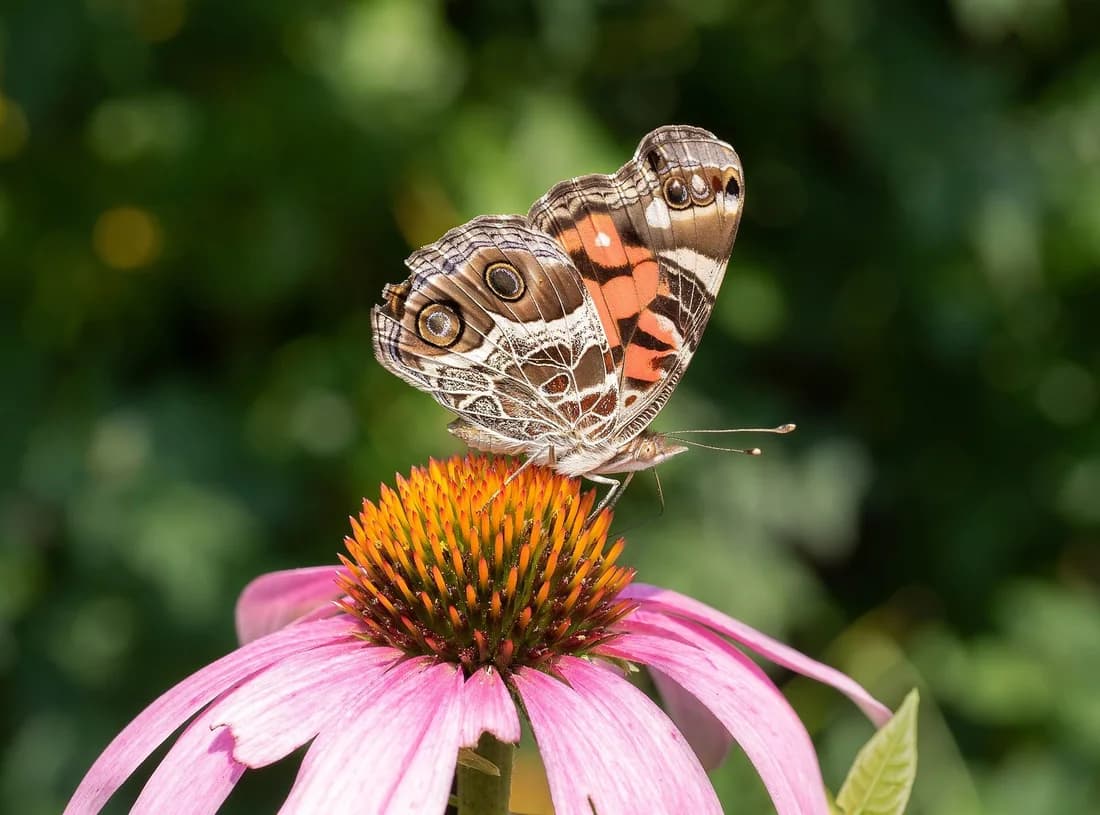
The American Painted Lady is an orange, black and white butterfly very like the Painted Lady, but with two very large eyespots on its marbled hindwing underside. A North American species, it is sometimes blown to Europe as a rare vagrant.
Wingspan 45–67 mm. The upper side is orange to yellow-brown with a black forewing tip carrying several white spots and a white dot in the orange field near the tip; a black pattern sits in the middle of the wing. The hindwing has blue-pupilled eyespots along the margin. The underside is the best field mark: the forewing is pink with the white dot, and the hindwing is whitish and marbled in browns with two very large eyespots.
Similar species
The Painted Lady (Vanessa cardui) looks very similar above but has four small eyespots on the hindwing underside instead of two very large ones, and the largest spot in its forewing tip is white.
Biology
The caterpillars feed on many plants, especially daisy-family plants such as cudweeds (Gnaphalium), pussytoes (Antennaria) and pearly everlasting (Anaphalis margaritacea). Young caterpillars live together in silk webs, older ones singly in spun leaves; they are whitish to yellow with branched black spines and many narrow black cross-lines. Where winters are cold the adults cannot survive. It is a strong migrant and is sometimes carried across the Atlantic to Europe.
Facts by country
The description above applies everywhere. Status, flight period and distribution apply only to the selected country.
Status in this countryVagrant: fewer than 100 UK and Irish recordsNA (Not applicable)3 recorded sightings
Records per month
JJanuary: 0
FFebruary: 0
MMarch: 0
AApril: 0
MMay: 0
JJune: 0
JJuly: 0
AAugust: 0
SSeptember: 1
OOctober: 2
NNovember: 0
DDecember: 0
Recorded sightings in the United Kingdom by month of the year.
Flight period
All records in the British Isles are from August to October, apart from two suspect records in July (Kent and East Sussex).
Distribution
An extremely rare natural migrant, first seen around August 1828 at Withybush, near Haverfordwest, Pembrokeshire. There are fewer than 100 records, all confined to the south and west coasts of England and Ireland; it is believed to come from the east coast of the USA or from the Canary Islands, Madeira or Portugal, and is almost certainly overlooked because it resembles the Painted Lady.
In Ireland
Status in this countryVagrant: very few Irish recordsNA (Not applicable)
Flight period
No regular flight period in Ireland, as the species is not resident there.

 United Kingdom
 Ireland