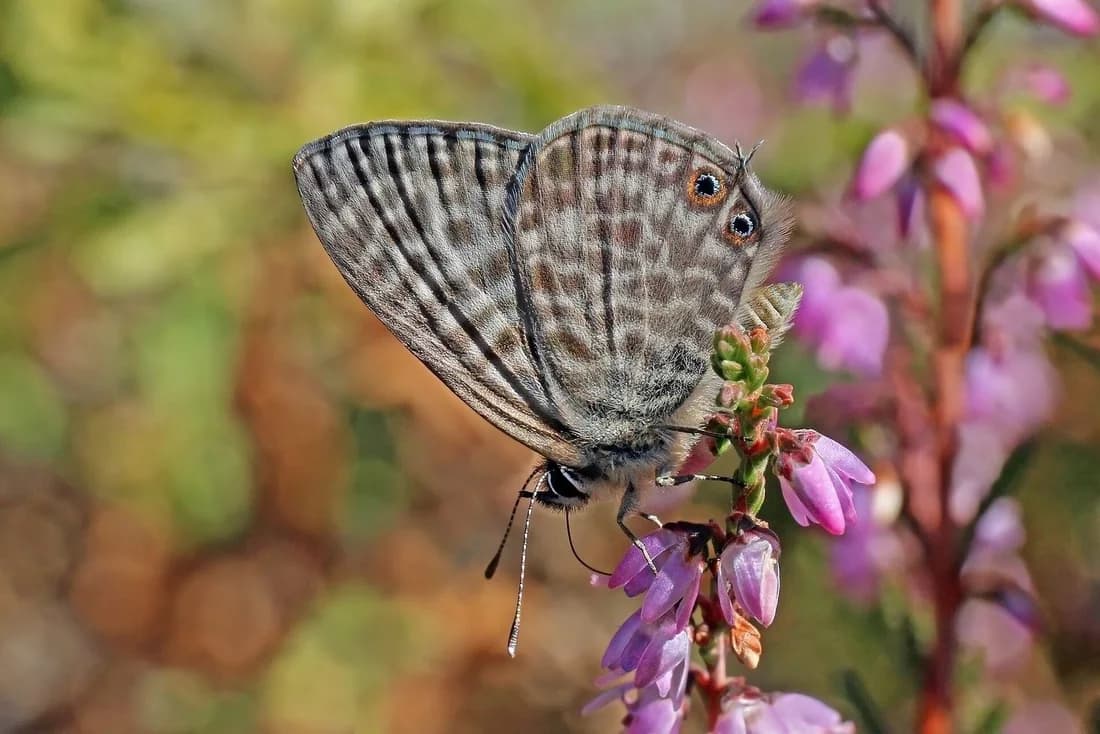
Lang's Short-tailed Blue is a small blue butterfly with two thin tails, a finely patterned brown-grey underside and two orange eyespots by the tails. It lives around the Mediterranean and eastwards through Asia, and only rarely migrates further north.
Hot, dry places in varied natural habitats, lucerne fields, cultivated land and gardens.
Identifying features
Wingspan about 21–34 mm. The male is violet-blue to blue-grey above, the female grey-brown with blue only near the base. Each hindwing has a thin tail and, above, two black eyespots ringed with white near the tail, one often faint. The underside is beige-grey to brown with a net of fine white and brownish lines and no white band; at the base of the tails sit two orange eyespots with blue centres.
Similar species
The Long-tailed Blue (Lampides boeticus) is clearly larger, 28–35 mm, and has a narrow whitish band across the hindwing underside. The underside pattern can also recall the Geranium Bronze (Cacyreus marshalli).
Biology
The caterpillars eat flowers and young fruits, mainly of legumes such as melilot (Melilotus) and lucerne (Medicago sativa), but also of plants in other families, for example leadwort (Plumbago) and heather (Calluna vulgaris). They are green or brownish with a dark back line and dark oblique stripes; the pupa is yellowish with brown markings. There are several generations a year, and a life cycle takes four to eight weeks. It is a regular migrant.
Facts by country
The description above applies everywhere. Status, flight period and distribution apply only to the selected country.
In the United Kingdom
Status in this countryVagrant: a single UK record (1938)NA (Not applicable)2 recorded sightings
Records per month
JJanuary: 0
FFebruary: 0
MMarch: 0
AApril: 0
MMay: 0
JJune: 0
JJuly: 0
AAugust: 0
SSeptember: 0
OOctober: 2
NNovember: 0
DDecember: 0
Recorded sightings in the United Kingdom by month of the year.
Flight period
The single UK specimen was caught on 13 June 1938. No UK flight period is given in the sources consulted.
Distribution
A single male was caught on the edge of an uncut clover field at Bloxworth, Dorset, on 13 June 1938; it is believed to have arrived with a general influx of immigrants on the south coast of England. The species is known to migrate.

 United Kingdom