
Identifying features
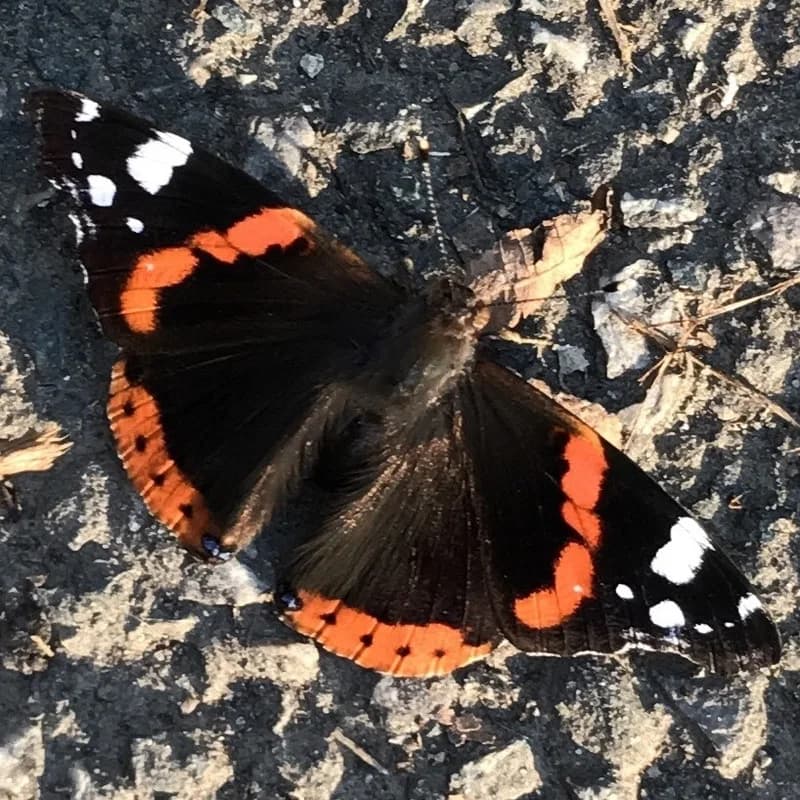
Wingspan 53–63 mm. The upper side is dark brown to black, with a broad diagonal red band on the forewing, and white spots outside of this. The hindwing has a broad red edged band with black spots, with a bluish-marbled area near the rear corner. In repose, the red band is concealed by the mottled underside of the hindwing, which is brown, grey, and black.
Similar species
No confusing species are described in the sources examined. For the Swedish practical butterflies, the combination of a dark base colour, diagonal red bands, and white edged spots is characteristic.
Distribution
Red admiral is an annual immigrant in Denmark, Sweden, Norway, and Finland since the 1960s and has become increasingly common since the beginning of the 1990s. The species is established and reproducing in Sweden, with southward migration noted in Southern Scania. Its global distribution extends from the Canary Islands and North Africa through Europe to Southern Ural and Kazakhstan, as well as across all of North America.
Biology
She lays her eggs scattered, one by one, stinging nettles, preferably in shadier deciduous forest or garden environments. The larva, green-grey or dark brown with yellow-white spots, spins together a nettle leaf, which it consumes from within. Pupation occurs on the underside of the nettle leaf. Development from egg to butterfly takes a few weeks during the height of summer.