
Identifying features
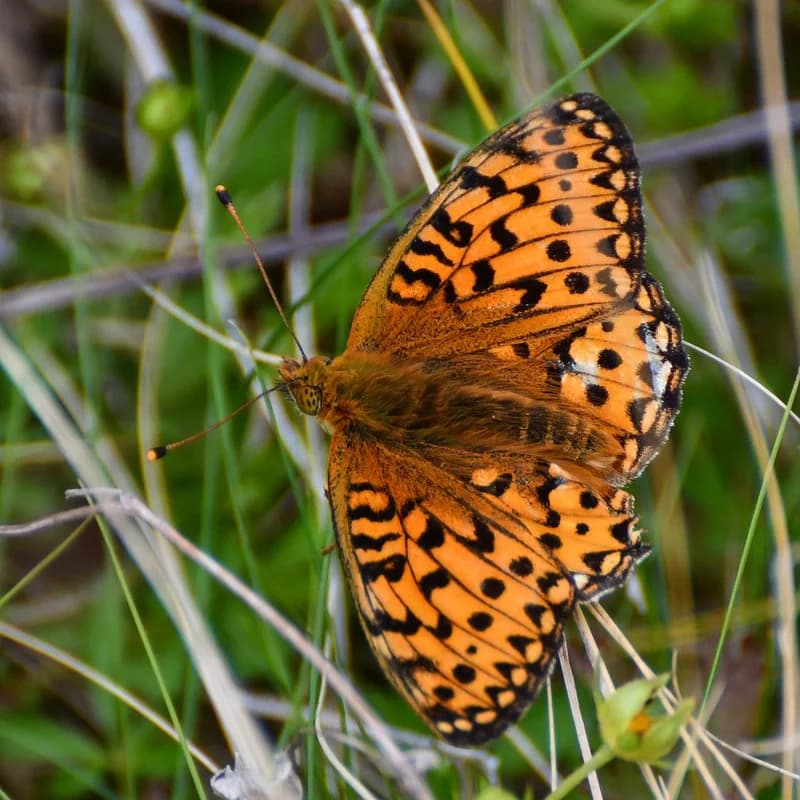
Wingspan 45–58 mm. The male’s upper side is yellowish-red with black spots and scent scales on the wing veins; the female varies from yellowish-red with small black spots to dark yellowish-brown with greenish-black dusting near the wing base. The underside of the hindwing is olive-green on the inner part with 12–14 silver spots, of which the larger ones are ovally extended in the direction of the wing veins. Further outwards, the hindwing is yellowish-brown and without brown eye spots – which distinguishes the species from forest- and Niobe fritillary. The edge has small silver spots within green margins.
Similar species
Differentiated from High brown fritillary and Niobe fritillary by the fact that the outer part of the hindwing lacks brown eyespots on the underside. Otherwise, no confusing species are described in the examined sources.
Distribution
Evenly distributed throughout the entire Sweden area, from Skåne to southern Lapland; also found in neighbouring countries in all provinces. In Norway, it can be found along the entire coastline to Troms. The global distribution encompasses all of Europe, excluding the isolated islands and coastlines of the Mediterranean and Atlantic, and extends from the Atlas Mountains in North Africa to Kazakhstan, Tian Shan, Altai, and Japan.
Biology
Host plants are several violet species: shrub violet, bog violet, sand violet, shore violet, woodland violet, and meadow violet. The female lays eggs, scattered one at a time or in small groups, on larger plants growing in sun-exposed locations. The newly hatched larva only consumes the eggshell before overwintering among the ground’s leaf litter; it becomes active again in the middle of April and reaches full size in the first half of June. Pupation occurs in crevices, very close to the ground surface, preferably on rocks and stumps; the pupal stage lasts 2–3 weeks. Both sexes are active and frequent visitors to flowers, with a particular preference for Saxifraga, Galium, and thistle. Due to fertilisation, the species has significantly decreased in cultivated landscapes.