
Identifying features
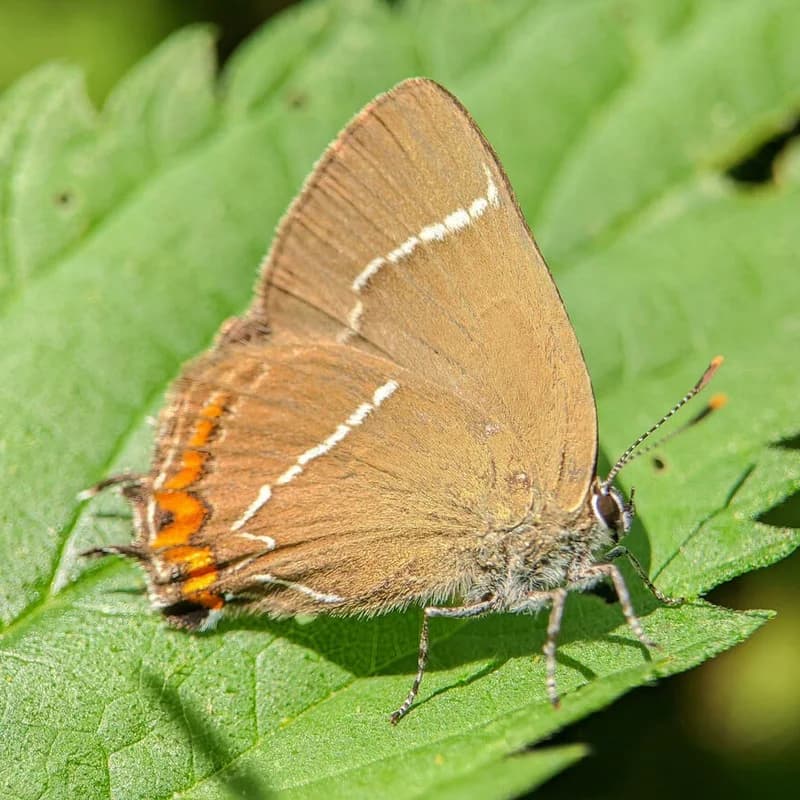
Wingspan 26–32 mm. The upper side is dark brown with slender, small projections at the base of the hindwings. The male has a small, oval, light grey scent scale spot in the disc, and the female has a small, yellowish-red spot at the rear corner of the hindwing. The underside is lighter brown with a thin white transverse line that on the hindwing forms a “W”; the hindwing has a yellowish-red edging band limited inwards by a wavy black line. The white transverse line is more continuous than in busk- and ilex hairstreak.
Similar species
Similar to Black Hairstreak (Satyrium pruni) and ilex hairstreak (S. ilicis), but white-letter hairstreak, with its white transverse vein on the underside, exhibits a more continuous pattern without clear breaks.
Distribution
In Sweden, a predominantly low-lying type, mainly along the coasts and at the northern boundary in connection with Vänern, Hjälmaren, Mälaren, and adjacent water systems; found northernmost in the southernmost parts of Dalarna and Hälsingland. In Norway, from Vest-Agder to Oslofjord; in Denmark, widespread, except on the western side of Jutland; in Finland, only in Åbo and Helsingfors. The worldwide distribution is bimodal: Europe and Turkey with an eastern boundary in the Ural, and East Palearctic to Japan.
Biology
The host trees are elms, mainly wych elm. The fully developed larva overwinters in the egg and hatches at bud break. Larval development takes 7–10 weeks and the pupal stage 2–4 weeks. Males gather for mating displays in the treetops and rub their hindwings together, moving the white-tipped tails and misleading birds into attacking the wrong end of the butterfly. Their main food source is honeydew from aphids. Dutch elm disease is a serious threat because only larger trees flower, and these are most vulnerable.