
Identifying features
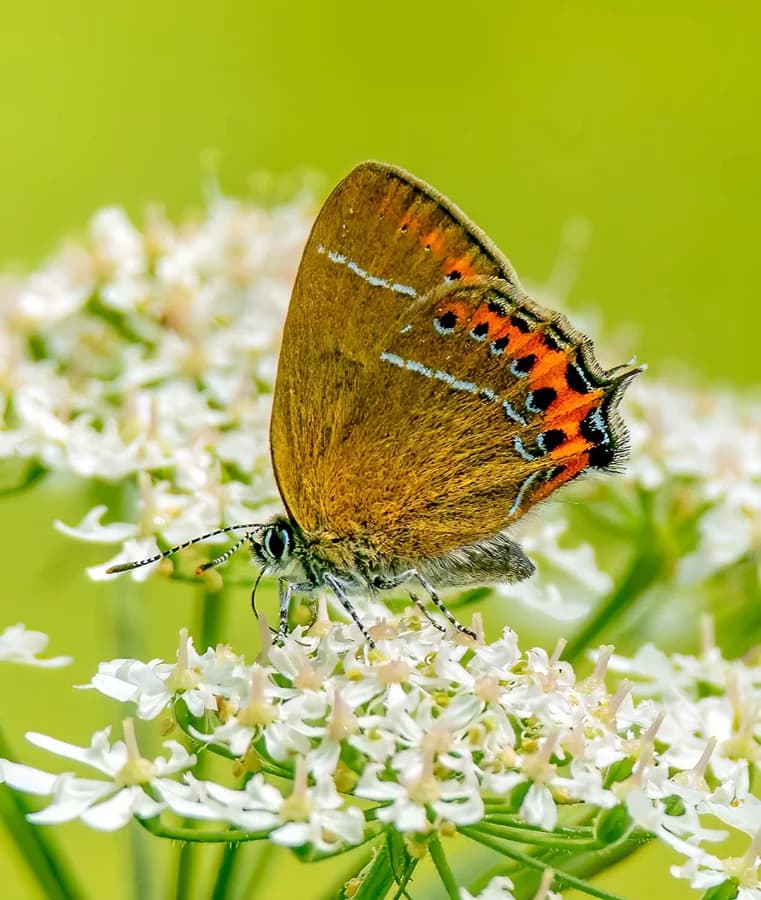
Wingspan 30–35 mm. The upper side is dark brown with a thin tail projection on the hindwing; the male has a light grey scent scale spot in the disc cell and an irregular, diffuse border of yellow spots on the hindwing below; the female has an edge band of yellow spots on both wing pairs. The underside is yellowish brown with a transverse line of broken white streaks and a yellow-red edge band bordered inwards by black dots with a thin white outline.
Similar species
Similar to ilex hairstreak (Satyrium ilicis) and white-letter hairstreak (S. w-album); ilex hairstreak has a less widespread orange marking on the underside of the hindwing, without a border of distinct black margins and round spots.
Distribution
From Sweden in Skåne and Blekinge to Öland and eastern Småland, where it currently has its primary distribution area; since the late 1990s, it has expanded northwards to Östergötland. Denmark is now likely extinct. Its global distribution extends from northern Spain through Europe and Siberia to Altaj, Mongolia, the Amu area, Japan, and Korea.
Biology
The most important host plant is blackthorn (Prunus spinosa). Overwintering occurs as a fully developed larva within the egg, and the newly emerged larva feeds early in the spring into a cracking leaf bud. The growth period takes four to eleven weeks, and pupation occurs against a twig; the pupa resembles bird droppings. The populations are usually sparse, and the species is often overlooked. Honeydew from aphids is likely the primary source of nutrition.