
Identifying features
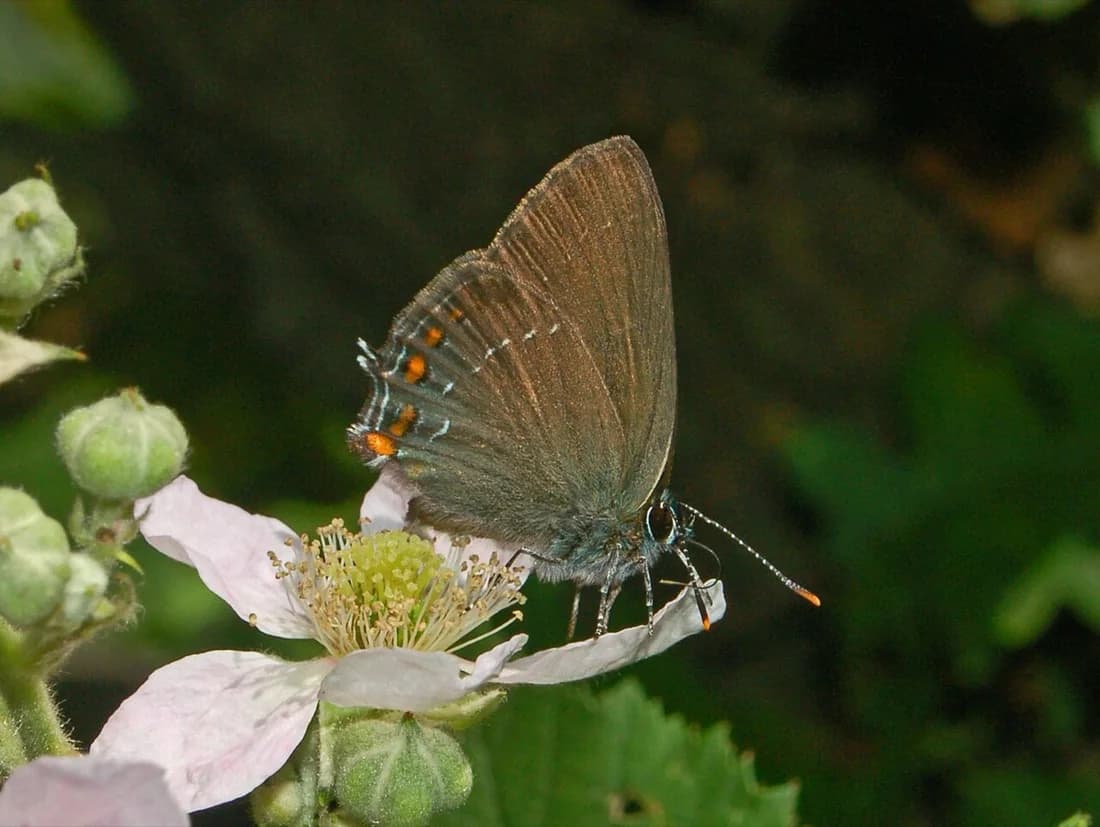
Wingspan 28–34 mm. The upper side is dark brown, with short tail extensions on the hindwings, and a yellow-red spot at the rear corner; the female has a large yellow-red spot on the forewing. The underside is brown, with a thin, white, regularly broken cross-line resembling stitches through fabric, from the front edge of the forewing to the rear corner of the hindwing. On the hindwing, there is a band divided into yellow-red spots.
Similar species
Similar to its closest relatives, white-letter hairstreak (Satyrium w-album) and Black Hairstreak (S. pruni), but with a less extensive orange pattern on the underside of the hindwings, and the orange patch lacks a border of distinct black margins and round spots.
Distribution
In Sweden in eastern Skåne (from the southeast corner to Brösarp and Vä), and between Bromölla and Rödeby in Blekinge, and along a power line route into Småland (Nybro). Extinct in Denmark. The global distribution extends from northern Spain eastward to Lebanon and the southern Ural.
Biology
The larvae live on oak and birch, and overwinter as fully formed in the egg; they break through the shell upon bud emergence and initially feed on buds and young leaves. Growth takes 4–5 weeks, and pupation occurs on dry leaves on the ground. The female lays fewer than 100 eggs. The butterflies remain primarily in the lower, shaded parts of the tree crowns, where the males gather for mating rituals. Unlike other tree-bound fastwings, it also visits low-growing flowers such as thyme.