
Identifying features
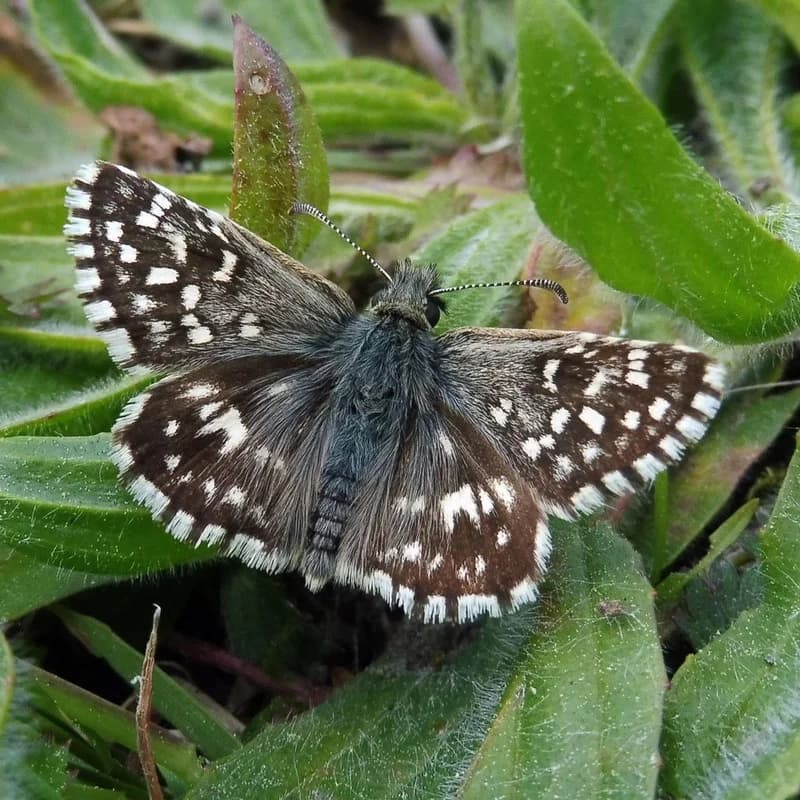
Wingspan 20–24 mm. The wings have a dark grey to black base colour on the upper side, with sharply defined, pure white spots. The forewing often has a line of clear white spots near the outer edge. The size is a good characteristic in the field: it is smaller than Northern grizzled skipper, Alpine Grizzled Skipper, and large grizzled skipper.
Similar species
The species is smaller than Northern grizzled skipper, Alpine Grizzled Skipper, and large grizzled skipper, which is a useful characteristic in the field. Oberthürs grizzled skipper is slightly larger, but lacks sharp white spots on the upper side of the hindwing. The pattern on the underside of the hindwing is relatively consistent and useful for species identification in cases of uncertainty.
Distribution
Grizzled skipper is widespread throughout southern Scandinavia, but rarer near the border defined by the Gudbrandsdalen in Norway and the High Coast in Ångermanland. The global distribution extends from Spain and England through Europe and Siberia to Japan. The population trend is stable in Sweden.
Biology
The host plants are wild strawberry and various low-growing cinquefoils, mainly tormentil. The butterfly flies fast and is difficult to follow; it is best studied when visiting flowers or resting with open wings on a warm surface. The species usually stays close to its breeding site.