
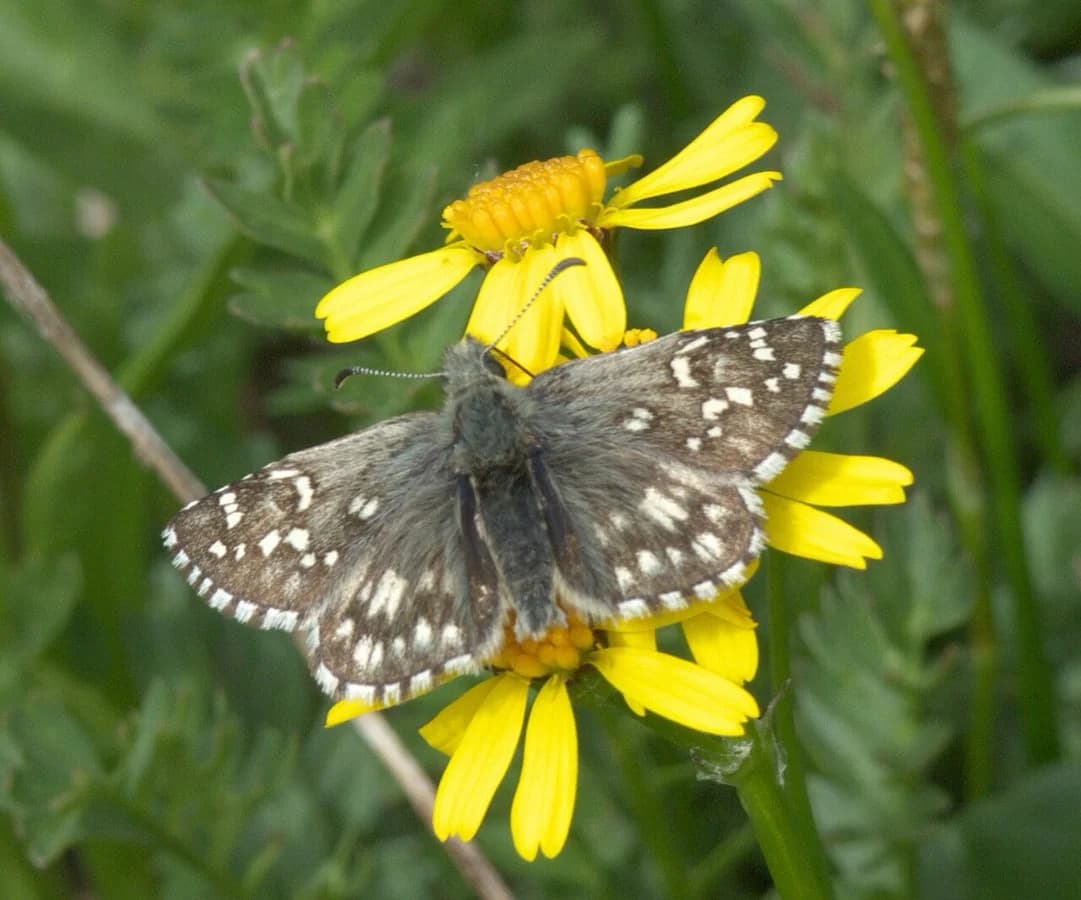
Identifying features
Wingspan 28–32 mm. The wings are dark brown on the upper side, with large, clear white spots, and are covered in grey hairs; individuals from Lapland are more densely and lighter coloured with hairs, so the wings appear greenish-grey. The underside of the hindwing is dark brown with white veins and white spots.
Similar species
It resembles Grizzled skipper, large grizzled skipper, and Alpine Grizzled Skipper. On the underside of the hindwing, the inner edge of the transverse band has an inwardly facing white spot in the center – unlike Grizzled skipper and large grizzled skipper, where the inner edge is even.
Distribution
Northern grizzled skipper is found from northern Västerbotten to the northernmost Lapland (Sweden), but is less prevalent in coastal regions; it is found in all mountain areas’ peatlands. In Finland, its distribution is more sparse than for other northern diurnal butterfly species associated with peatlands.
Biology
The males use both patrolling and stationary surveillance to find a partner. This species typically inhabits wetlands, but also visits flowers in more open and drier areas where the wetlands transition naturally, for example, along power lines.