
Identifying features
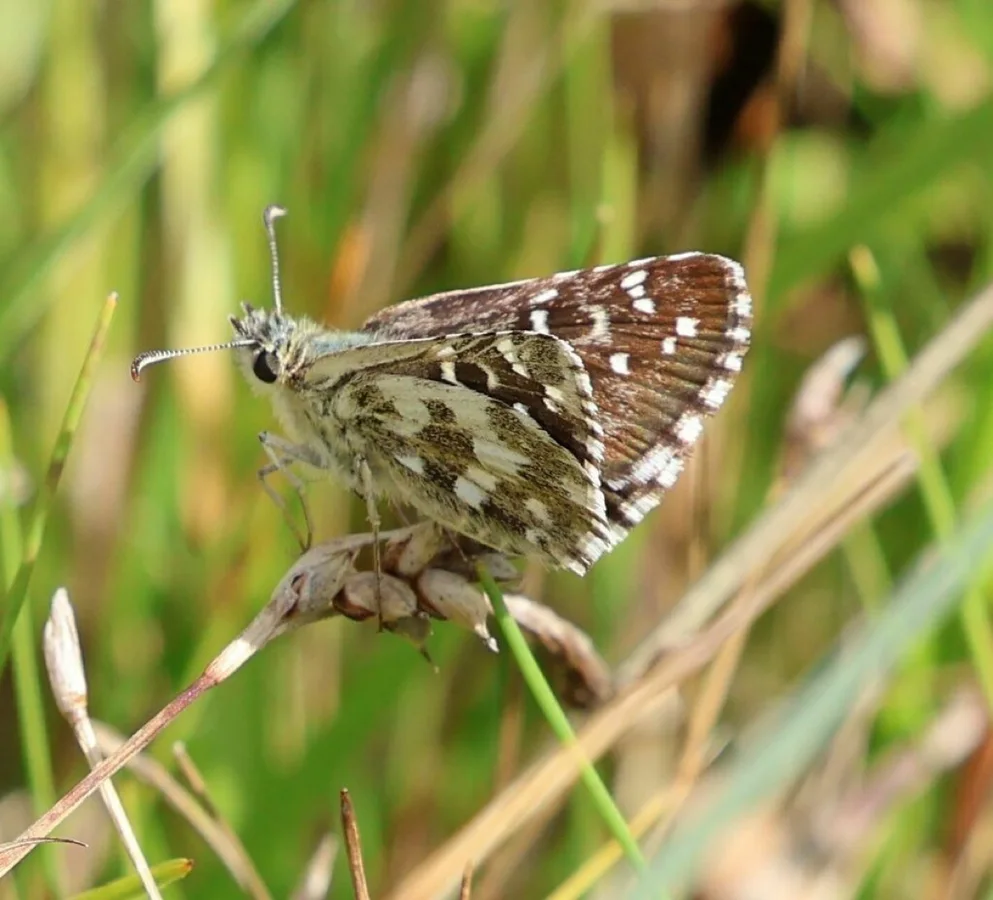
Wingspan 26–29 mm. The wings are dark grey to dark brown on the upper side, with clear white spots on the forewings, and more diffuse light grey spots on the hindwings. The underside of the hindwing is brown with large, sometimes merging, white spots; the white band has a smooth inner edge in its upper half. Unlike Grizzled skipper, there are no white edge spots on the upper side of the forewings.
Similar species
The species is very similar to Grizzled skipper, Northern grizzled skipper, and Alpine Grizzled Skipper. It differs most clearly in the markings on the underside of the hindwing: the inner edge of the white band is smooth, without the inwardly projecting white tip that Northern grizzled skipper and Alpine Grizzled Skipper have.
Distribution
Large grizzled skipper has always been considered rare within the Fennoscandian distribution area, and the lowest number of finds is found in Sweden. The distribution is clearly focused on regions with lower annual rainfall or habitats with large areas of bare ground.
Biology
The host plants are Helianthemum nummularium and Helianthemum oelandicum in southeastern Sweden; across much of its range in the Nordic countries, the species must have additional host plants. The female lays scattered eggs individually on the upper surfaces of leaves. After a few weeks of growth, the larvae overwinter in a silk shelter.