
Identifying features
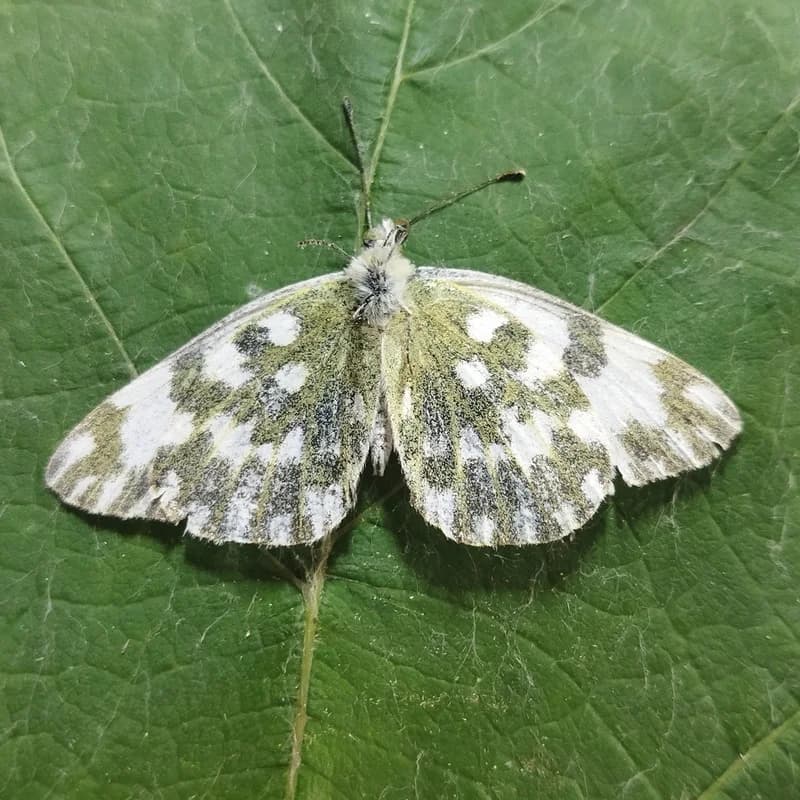
Wingspan 33–48 mm (wing width). The upper side of the wings is white; the forewings have a broad black patch, broken by white areas at the tip, and a black square spot. The female also has a black spot at the lateral edge and black spots in a row along the outer edge of the hindwings. The undersides are white with mainly green spots, primarily on the hindwings.
Similar species
The species may possibly be confused with the female of orange tip.
Distribution
Eastern Bath White is a migratory species recorded in many Swedish provinces during the 20th century; the influxes originate in southeastern Europe. In 1970, 1972 and 2000, large influxes from the east reached as far as Lapland. Today it is known to be permanently resident only on Gotland, with populations on the pale calcareous ground at Mästermyr and in Stånga gravel pit. Its world distribution covers much of the Palaearctic region.
Biology
The larvae develop from late June through the entire summer. Various cross-pollinating plants are reported as hosts; on Gotland, only yellow sorrel has been observed. The species overwinters as a pupa. The butterfly visits various flowers, including thistles and thyme. The species requires dry and warm soil, often affected by human activity.