
Identifying features
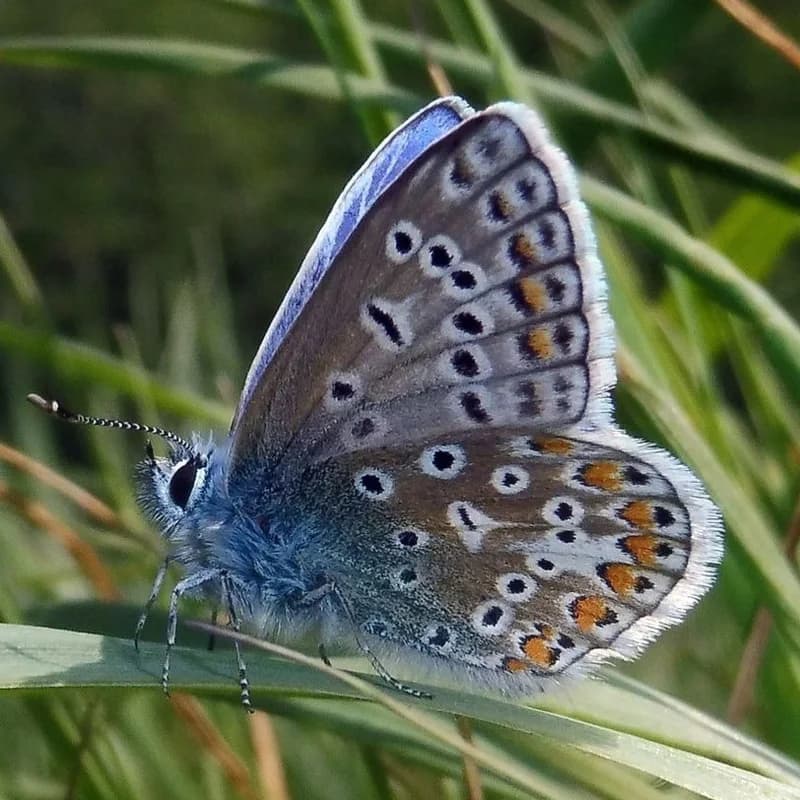
Wingspan 21–33 mm. The male’s upper side is iridescent blue with a very narrow black border. The female appears in both brown and blue forms; in the north, females with blue upper sides and yellow-red borders predominate. The underside is grey-brown in the male and light grey-brown in the female, with shining blue-green scales in the wing veins. One of the best identifying features is 1–3 spots within the streaked disc spot on the underside of the forewing.
Similar species
Similar to Amanda’s blue (Polyommatus amandus), but differing from it in that it has a white wedge on the underside of the hindwing and black spots within the forewing patch on the underside of the forewing.
Distribution
Widespread and common throughout Northern Europe, from Norway to Lofoten, Troms, and Finnmark; resident on Gotland Island. One of Europe’s most widespread blue wing varieties. Its distribution extends from the Canary Islands and North Africa, through Europe, to northern Ural, Kazakhstan, Altai, and Tian Shan.
Biology
The most abundant growth is bird's-foot trefoil (Lotus corniculatus), but the species also uses red clover, white clover, alfalfa leaf beetle, and various types of thorn bushes. The female lays eggs on young plants, preferably on the upper side of young shoots or near flowers. The development is rapid, and the species overwinters in its fourth larval stage. The males are both territorial and patrolling.