
Identifying features
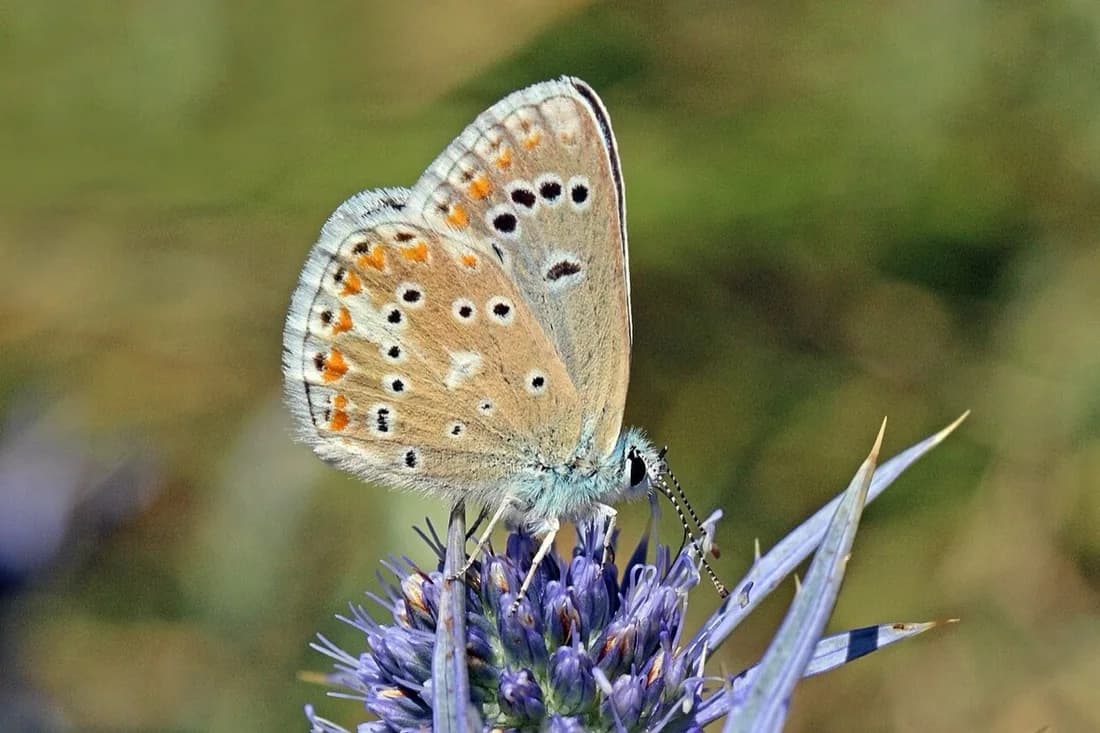
Wingspan 28–35 mm. The male’s upper side is satin-bright light blue, with narrow black markings that gradually become wider towards the front edges. The female is brown, with diffuse yellowish-red margins. The underside is very characteristic: a base colour ranging from ash grey to light brown, broad white borders, larger black spots with a white ring on the forewings, smaller black spots with a white ring on the hindwings, and small yellowish-red margins.
Similar species
The males differ from common blue (Polyommatus icarus) in the field through a more intense and brighter blue colour.
Distribution
In several locations in southeastern and northeastern Scania, more prevalent but relatively rare in Öland and Gotland; formerly also in Blekinge, Småland, and Uppland. Never found in Denmark. The global distribution includes southern and central Europe, as well as Turkey, with a northwestern boundary from northern Spain to central Germany and Sweden.
Biology
The plant is Anthyllis vulneraria. The eggs are laid one at a time on thick, older leaves near the ground surface. The larvae tunnel into the leaves, are attended by ants, and overwinter in their second stage; after overwintering, they grow for approximately two months and then feed primarily on the flowers. The males patrol rapidly over fairly large territories.