
Identifying features
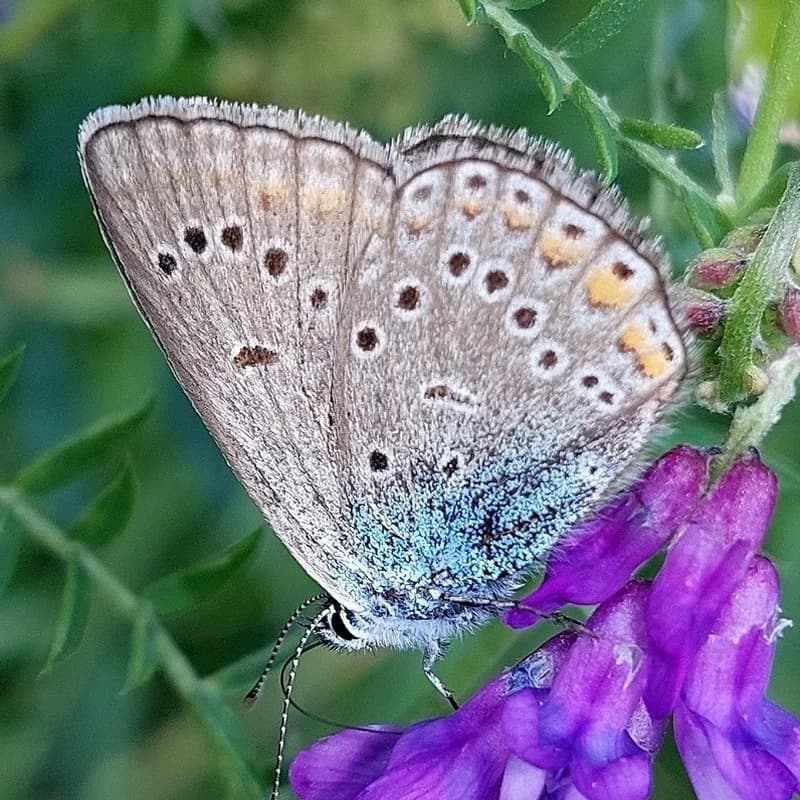
Wingspan 31–36 mm. The male’s upper side is silvery-light blue with a narrow black border, edged with grey-black dusting on the wing veins. The female can be entirely brown, but is particularly, in Sweden in the middle and northern regions, more or less blue from the center towards the base. The underside is ash grey with clear, streaked disc markings and clear dot lines.
Similar species
Differentiates from common blue (Polyommatus icarus) by lacking the white markings on the underside of the hindwing and the black spots within the discocellulars on the underside of the forewing; it is also generally somewhat larger.
Distribution
In Sweden, across much of the country, from northern Värmland through the agricultural areas of Dalarna and Hälsingland, and further into coastal areas northwards to Norrbotten; expansion has been significant in Norrland. In Norway, in the southern and eastern regions; in Finland up to 67° N. The global distribution extends from North Africa through Europe, Turkey, the Caucasus, Central Asia and Siberia, to Mongolia, northern China and the Amu region.
Biology
Host plants include several members of the pea family, such as meadow vetchling, tufted vetch and alfalfa. Eggs are laid singly on the upper side at the base of a leaf and hatch after about a week. The larva is attended by ants and overwinters as early as its second instar. Males often patrol open corridors in woodland with meadow-like vegetation and gather in flower-rich areas.