
Identifying features
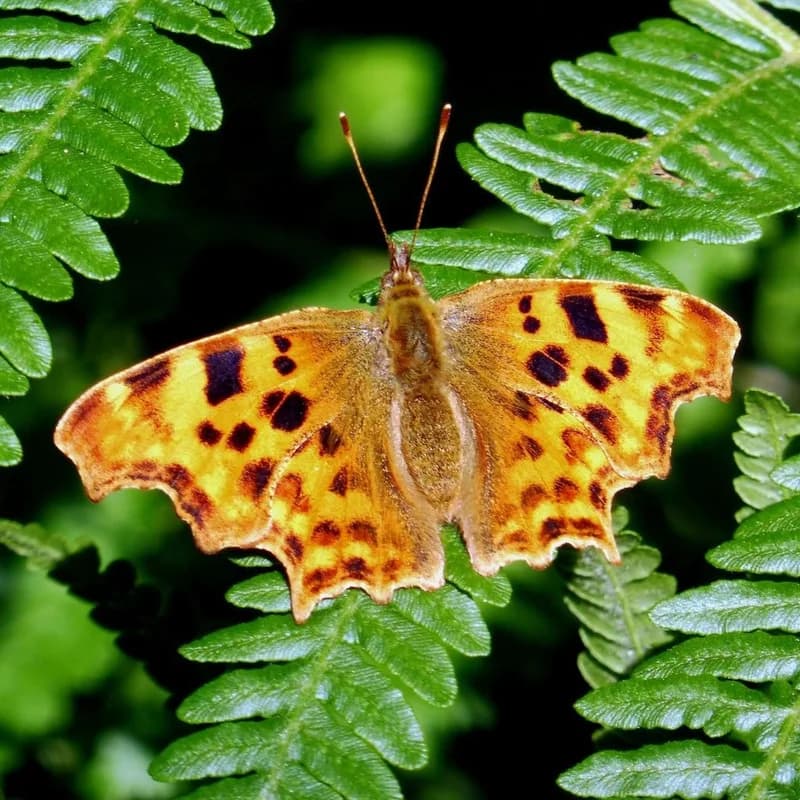
Wingspan 40–50 mm. The upper side of the wings is a darker or lighter yellowish-red, with grey-black or dark brown edges, two larger black marginal spots, and several smaller spots; the outer edge of the wings is irregular and fringed, slightly smaller in females. The underside is mottled in shades of grey-black or brown, often with splashes of grey-blue or olive green. Good identifying features include the silver C-shaped marking on the underside and the strongly inwardly bent lower edge of the forewing. The sexually mature summer generation, form hutchinsoni, has a lighter underside and a lighter yellowish-red upper side.
Similar species
No similar species are described in the sources consulted.
Distribution
Fairly common throughout Fennoscandia, except in mountainous areas and the majority of the boreal coniferous forest region; in Norrland primarily found in river valleys and near the coast, north to northern Bothnia. Rare in Denmark and western Norway. The global distribution extends from western North Africa, Portugal, England, and Norden, through Europe, the Middle East, the Caucasus, and Siberia, to Mongolia and Japan. Population trends are stable throughout Europe.
Biology
The main host plants are goat willow, elm, hop, stinging nettle, hazel and currants. The female lays scattered single eggs over a long period until July; egg development takes one week and larval development 3–4 weeks. On hop the larva often bites through the leaf’s midribs, causing the leaf to collapse into a tent-like shelter. After 2–3 weeks the butterflies emerge from early July into August. They feed for a short time before seeking overwintering shelters near the ground. In spring they feed mainly on nectar from willow flowers, and in summer on thistles and other tall flowers as well as tree sap. They are readily attracted to strings dipped in sweetened wine.