
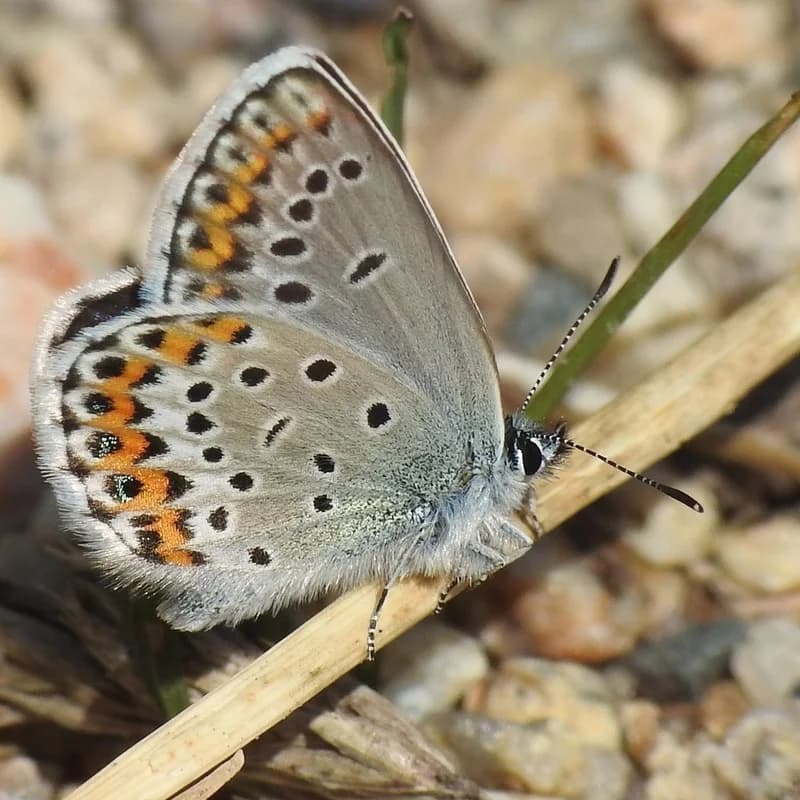
Identifying features
Wingspan 21–28 mm. The male is blue on the upper side, with narrower and more sharply defined black markings than in Silver-studded blue; the hindwings have a series of black spots that are often clearly distinguishable. The female is also more blue on the upper side in southern Sweden compared to Silver-studded blue female. The easiest way to distinguish the species is that Idas blue lacks the curved spike at the tip of the front leg, which Silver-studded blue has. The underside is lighter in the male than in the female.
Similar species
Similar to Silver-studded blue (Plebejus argus) and Reverdin’s blue (P. argyrognomon); Idas blue lacks the curved spike at the end of the foreleg, which only exists in Silver-studded blue.
Distribution
Occurs throughout Northern Europe up to 70° N in Finnmark, but is absent from Iceland; resident on Gotland Sand Island. Primarily found in mountainous regions in Southern Europe. The global distribution extends from Europe, Turkey, and Transcaucasia to Altai, and in North America from Alaska to Labrador.
Biology
Host plants include, among others, common heather, bog bilberry, Öland privet, harris, and blackthorn. The eggs overwinter. The larvae have a close relationship with ants, which tend to them; the northern subspecies lapponica larvae are tended by northern meadow ants (Formica lemani). The lapponica subspecies has a two-year life cycle, overwintering in the first year as eggs and in the second year as pupae. The males patrol in their search for newly emerged females.