
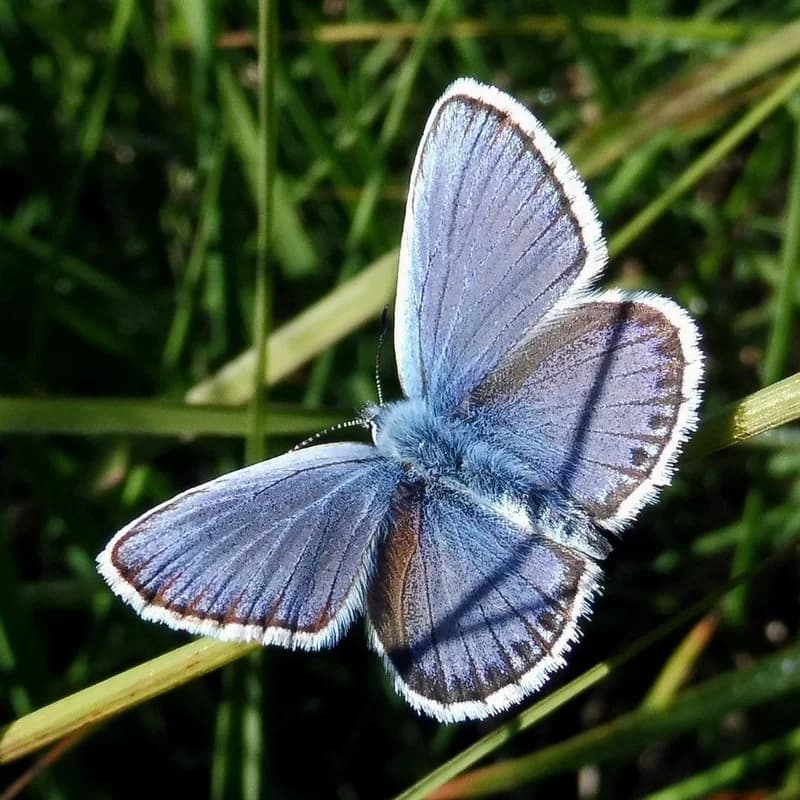
Identifying features
Wingspan 23–27 mm. The male’s upper side is blue with somewhat wider and less sharply defined black markings than in Idas blue; the hindwings have a series of black spots that give the markings an uneven inner boundary. The female is more brown on the upper side in the southernmost Sweden, compared to the female of Idas blue. The species are most reliably distinguished by the fact that Silver-studded blue has a clear, curved thorn at the tip of the front leg. The underside is lighter grey-white in the male, compared to the female.
Similar species
Similar to Idas blue (Plebejus idas) and Reverdin’s blue (P. argyrognomon); they are most clearly distinguished by the curved spike at the tip of the foreleg, which is only found in Silver-studded blue.
Distribution
In Sweden, it is widespread from Skåne to Jämtland and Norrbotten, with a few finds in Pite and Lule lappmark areas; more localised in northern Norrland. In Norway, it is present in all southern areas up to Möre-Romsdal; in Finland, up to 67° N. The global distribution extends from Europe and Turkey, through Siberia and Central Asia, to Mongolia, Magadan, Japan, and northern China.
Biology
Host plants include common heather, bog bilberry, wild thyme (rockrose), wild thyme, bird's-foot trefoil, and broom species; in Denmark, studies suggest that young heather plants are the primary host plant. The egg overwinters and hatches in April–May. The larva has a very close relationship with ants, particularly black ants, and is carefully tended by them; pupation often occurs in ant nests. Males are often found in large numbers around puddles on gravel roads.