
Identifying features
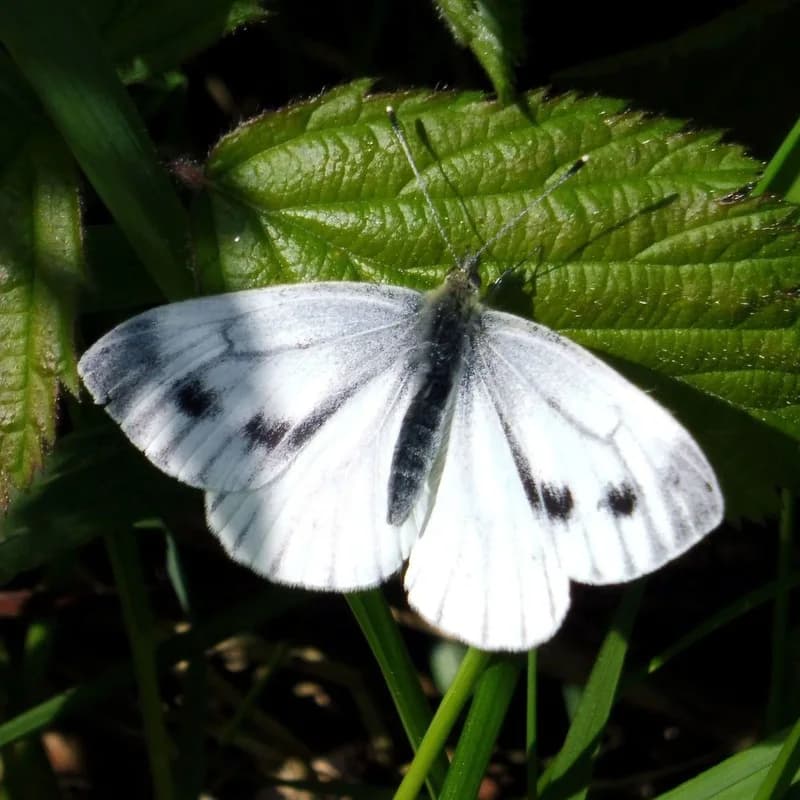
Wingspan 37–47 mm. The wings are white on the upper side, with grey or black markings: the forewing has a dark pointed spot, and the female has two round spots. This species is clearly distinguishable from other white hairstails in Scandinavia by the broad greenish-grey dusting on both sides of the wing veins on the underside of the yellowish hindwing.
Similar species
The species differs clearly from other white hairstrikes in Northern Europe through the broad greenish-black dusting on both sides of the wing veins on the underside of the hindwing – a reliable characteristic.
Distribution
Green-veined white is widespread throughout Northern Europe, but is more limited in precipitation-poor areas within the mountainous regions. Its global distribution encompasses all areas within the temperate climate zone in Europe, Asia, and North America. Population trends are stable in all countries in Europe.
Biology
Egg and larval development is very short, allowing several generations per season. Many of the cruciferous host plants benefit from disturbance and grow on road verges, fallow fields and shores, including garlic mustard and charlock. This is one of the few butterflies that also flies in cloudy but warm weather, and it is unpalatable to birds at every stage.