
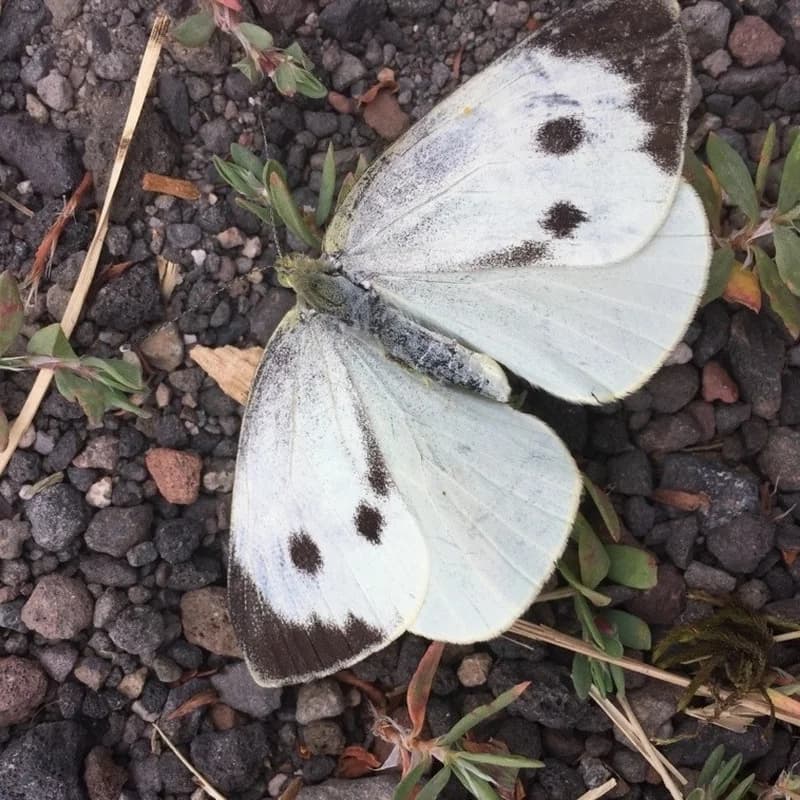
Identifying features
Wingspan 50–64 mm. The wings are white on the upper side, with a black tip on the forewing; the female also has two round black spots just outside the center of the forewing. On the underside, the wings are light yellow to pale yellow. Distinguishing it from small white is that the black spot at the corner of the forewing extends as far down along the outer edge as it does along the front edge, and from green-veined white on the uniformly coloured hindwing underside.
Similar species
From small white, this species is distinguished by the black spot on the forewing which extends as far down along the outer edge as it does along the leading edge, and from green-veined white by the uniformly coloured underside of the hindwing.
Distribution
Large white has been recorded throughout the Nordic region, but its pupa does not survive very harsh winters. The species therefore reproduces annually only in the southern coastal regions. From there it makes more or less annual migrations to 60° N, where a second generation emerges. Its global range extends from North Africa and Europe to Asia.
Biology
The larvae are well-known as serious pests of cultivated types of cabbage, primarily white cabbage, and also on radish, but can also survive on wild plants such as wild cabbage and mustards. The eggs are laid in groups of 50–100. The second generation is often characterised by very warm summers, frequently ten times more numerous than the first generation, and more prone to migration over long distances.