
Identifying features
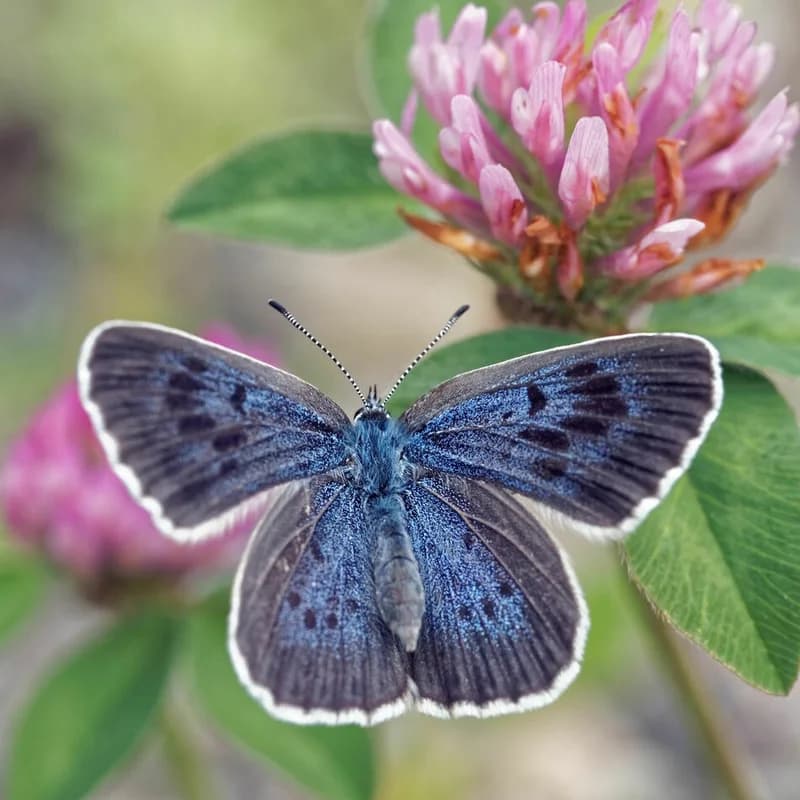
Wingspan 33–42 mm. The upper side is blue, with broad, slightly blurred grey edges; in the female, it is more dark brown but always blue at the center. Both sexes have several large, elongated black spots on the center of the forewings, and usually smaller black spots on the hindwings. The underside is light grey, with a full number of larger, white-ringed black spots and a rich amount of blue pigment near the base of the hindwing.
Similar species
Can only be confused with Alcon blue (Phengaris alcon), which, however, flies in entirely different environments.
Distribution
Previously widespread from Scania to Värmland and northern Uppland; today only moderately widespread on Öland and Gotland, otherwise only in a few locations on the mainland. Never found in Norway; decreasing in Finland and Denmark. The worldwide distribution extends from Spain and England through Europe and Siberia to Mongolia and North China. The species was successfully reintroduced in England with individuals from Öland.
Biology
The host plants are thyme (backtimjan and stortimjan), sometimes also known as mint (kungsmynta). The larvae initially feed on the flowers and then seek out ants from Myrmica sabuleti, bringing them to the nest where they feed on the ants' larvae and overwinter as nearly adult. The distance between the host plant and the ant nest should not exceed a few metres. The species is very vulnerable: it is long-term dependent on grazing which maintains the vegetation in a low-growing state and in sunny locations.