
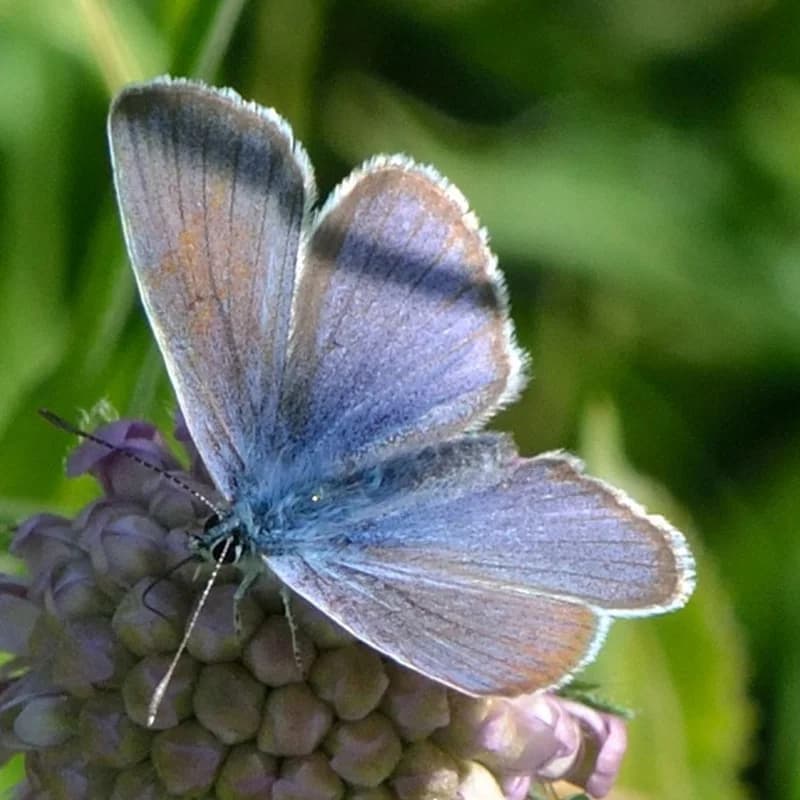
Identifying features
Wingspan 29–35 mm. The male is blue with a violet tinge and a rather glossy, velvety upper side, usually with a narrow, brown-grey border. The female is predominantly brown-grey with blue markings in the wing bases. The underside distinguishes it from large blue: featuring blue scales in the hindwing base, no black spots within the forewing disc, and smaller, more evenly distributed spots on both pairs of wings.
Similar species
Can only be confused with large blue (Phengaris arion), but differs through the underside markings and occurs in entirely different environments.
Distribution
Previously, from Skåne through Halland to southwest Västergötland and southernmost Bohuslän; now only present in several locations between Gothenburg and Herrljunga, a few in Halland, and one in Skåne. Absent in other Nordic countries, except for Denmark. The global distribution extends from northern Portugal through Europe and Siberia to Tian Shan, Mongolia, and Trans-Baikal.
Biology
In Sweden is entirely linked to marsh gentian (Gentiana pneumonanthe). The larva initially lives within the flower for 2–3 weeks and is then 'adopted' by ants – primarily garden red ants – which transport it to the nest, where it is fed as if it were the ants’ own offspring and also consumes ant larvae. The larvae overwinter in the ant nest and pupate there; the pupal stage lasts approximately three weeks. The butterflies are very locally faithful and feed on nectar.