
Identifying features
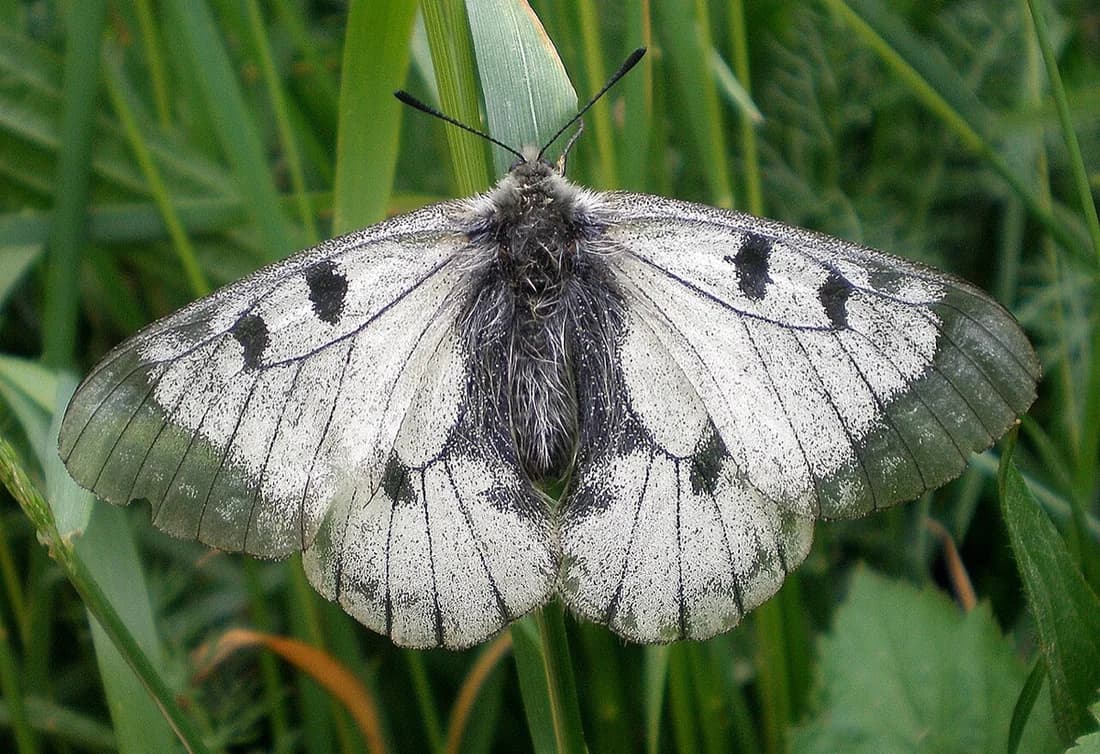
Wingspan 55–68 mm. The wings are white, with distinct black wing veins, two clear black spots in the disc field of the forewing, and a broad, translucent area in the outer part of the forewing. The hindwing has strong black dusting along the edge. The female can have strong black dusting over both pairs of wings.
Similar species
No similar species are described in the sources examined. Unlike Apollo, it has no red eyespots.
Distribution
Clouded apollo has previously existed in Scania, Blekinge, along the Kalmar Sound, on Öland and Gotland, as well as along the coast from Östergötland to Uppland. Today, it is only found in a few locations in Blekinge and along the central Uppland coast; the strongest populations are found in Medelpad. The species has been absent from Denmark since 1962.
Biology
The eggs are laid scattered on decaying plant parts. The larva overwinters fully formed in the egg and emerges in April; growth is rapid, and the larva is fully grown after approximately three weeks. The cocoon is produced in a rolled-up dry leaf, and the pupal stage lasts for about four weeks. The host plants are various Corydalis species, including southern Corydalis and Swedish Corydalis.