
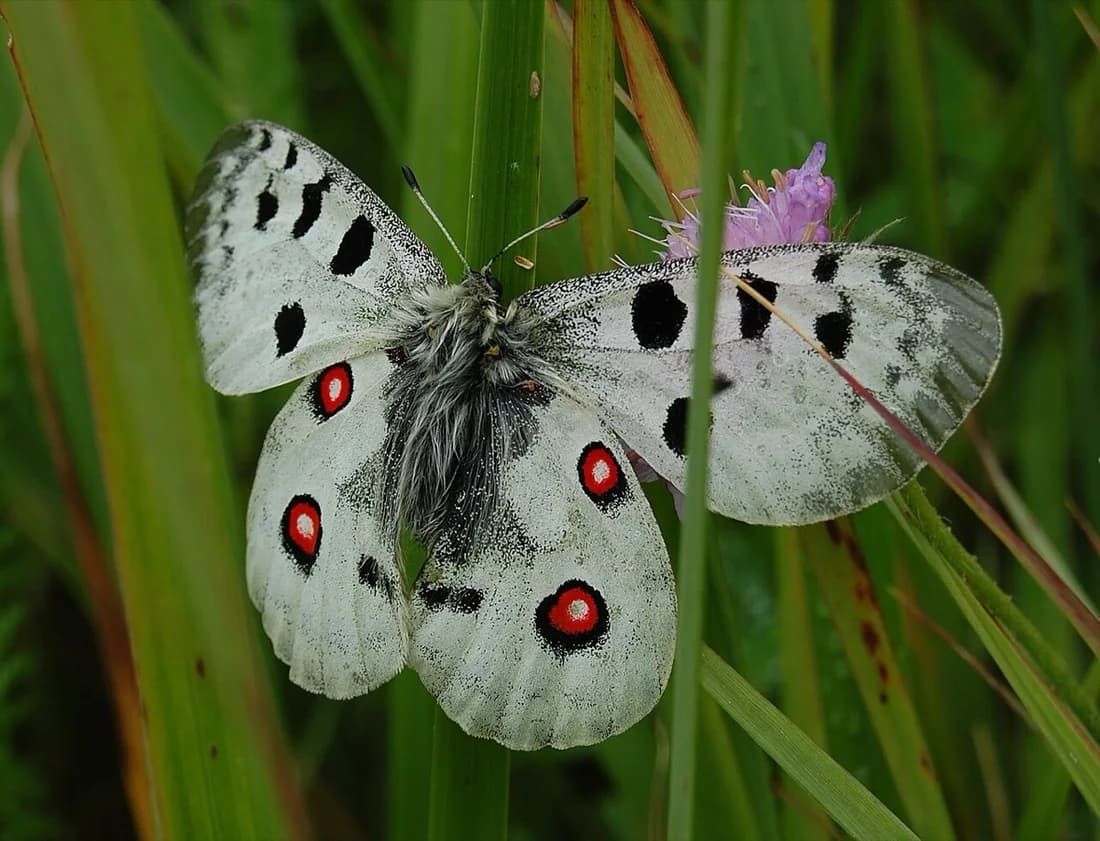
Identifying features
Wingspan 62–87 mm. The wings are pure white, but often appear greyish due to sparse, dark scales and a thin layer of scales. The forewing has four large black spots; the hindwing has two red eye spots ringed with black. Along the outer edge runs a translucent band. The female is usually larger and more robust, dark-powdered.
Similar species
No similar species are described in the sources examined. Clouded Apollo is similarly white but has no red eyespots.
Distribution
Apollo formerly occurred throughout southern and central Sweden, as far north as Ångermanland. Today it occurs in only a few limestone-rich areas, mainly Gotland, the southern Stockholm archipelago and the archipelago between Västervik and S:t Anna. The species is red-listed in several European countries and has disappeared from former sites such as Orust in Bohuslän.
Biology
The eggs are laid scattered on rocks, moss, and branches, often far from the host plants. The larvae overwinter in the egg and hatch early in the spring when the host plants, lovage and white willow, sprout shoots. The larvae feed actively and are selective in their diet. After approximately one month, the larva burrows into the ground and pupates; the pupal stage lasts 3–5 weeks.