
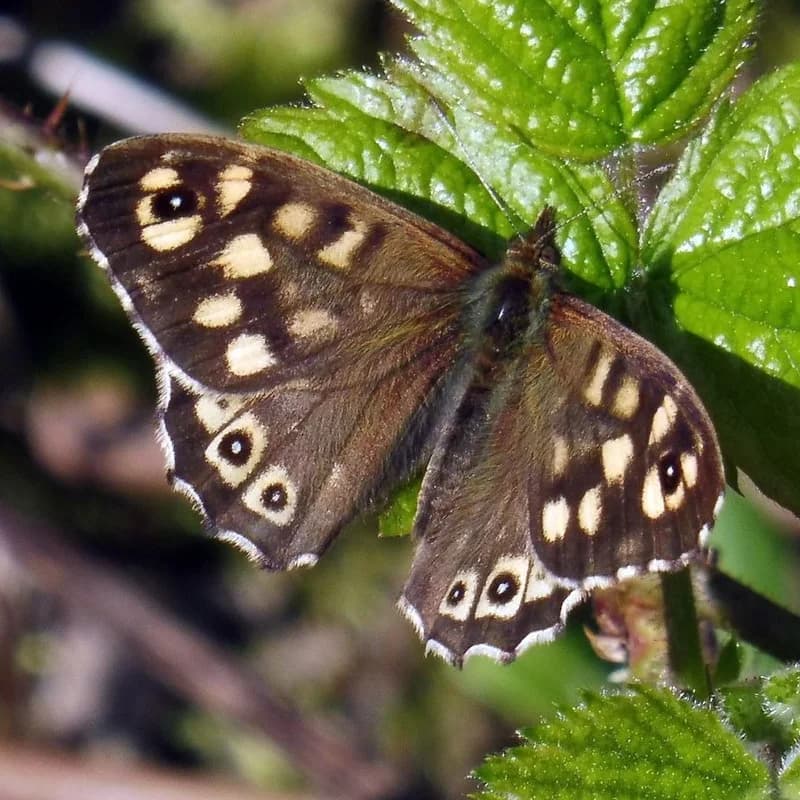
Identifying features
Wingspan 35–44 mm. The upper side of the wings is dark brown, with 9–12 light yellow spots on the forewing and six on the hindwing; in females, the spots are larger and paler. There is a clear eye spot on both the upper and lower sides of the forewing; on the hindwing, there are 3–4 eye spots. The underside is mottled in light yellow, yellowish brown, dark brown, and violet-grey shades. The second generation has smaller light yellow spots on the upper sides of the wings.
Similar species
No similar species are described in the sources consulted.
Distribution
Has migrated to Fennoscandia in several waves. The older northern distribution range extends south from Västergötland across the Småland highlands to Ångermanland in the north and Sör-Tröndelag in Norway. At the beginning of the 20th century, in Denmark it was only known from Lolland, subsequently spreading throughout the country, and from 1939 onwards to Skåne and Halland; the distributional gap between the populations appears to be closing. In Finland, it is primarily found in the southwest, and is now found as far north as 63°N. The global distribution encompasses North Africa and all parts of Europe except Iceland, with an eastern boundary in the Ural Mountains and Turkey. Population trends are stable or increasing throughout Europe.
Biology
The host plants are grass species, including tussock grass, heath couch, shepherd’s crown, mountain sedge, large vein grass, rock sedge, and pipe grass; in beech forests, lund couch is often found. The eggs are laid sporadically, one at a time, and egg development takes approximately one week. Larval growth varies in speed depending on whether the pupal stage will produce a new generation (3–4 weeks) or if the larvae will overwinter as nearly fully developed (2–3 months). The pupal stage lasts 2–3 weeks. The males emerge approximately one week before the females, and they select sunny spots on paths and forest trails for their territory.