
Identifying features
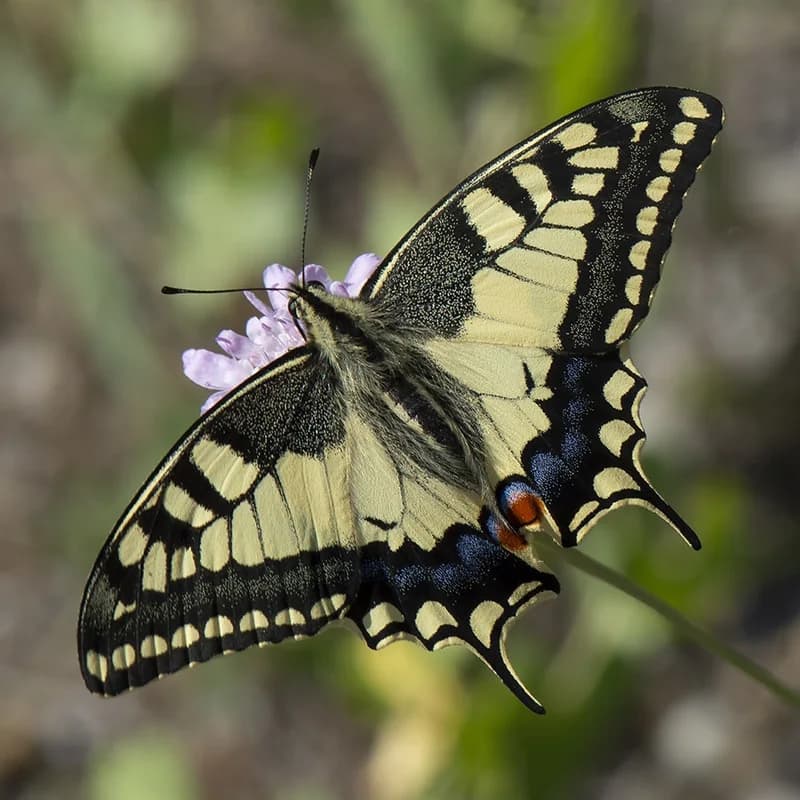
Wingspan 72–90 mm. The ground colour varies from bright yellow to yellowish-white. The forewings and hindwings have broad black transverse bands near the outer margins; the band on the hindwing is wider and has blue crescents. The long hindwing tails and false red eyespots can mislead birds. The forewing also has two black spots across the discal cell.
Similar species
No confused species are described in the sources examined. In Sweden, it is unmistakable due to its size, yellow colour, and tail projections.
Distribution
Old World swallowtail occurs throughout Sweden, but is seen less frequently in open agricultural areas and in mountainous regions. In Europe, the distribution is extensive; the global distribution includes all temperate and subalpine climatic zones up to 70° N, from North Africa through Europe and Siberia to Nepal and Japan, as well as in North America.
Biology
The female lays about 30 eggs a day for 1–2 weeks, singly on the youngest, most tender leaves. Milk parsley is the most frequently used host plant in inland habitats. In warm, calm weather, males gather at the highest points in the landscape, such as rocky knolls or high hills. This behaviour, called hilltopping, promotes mating success.