
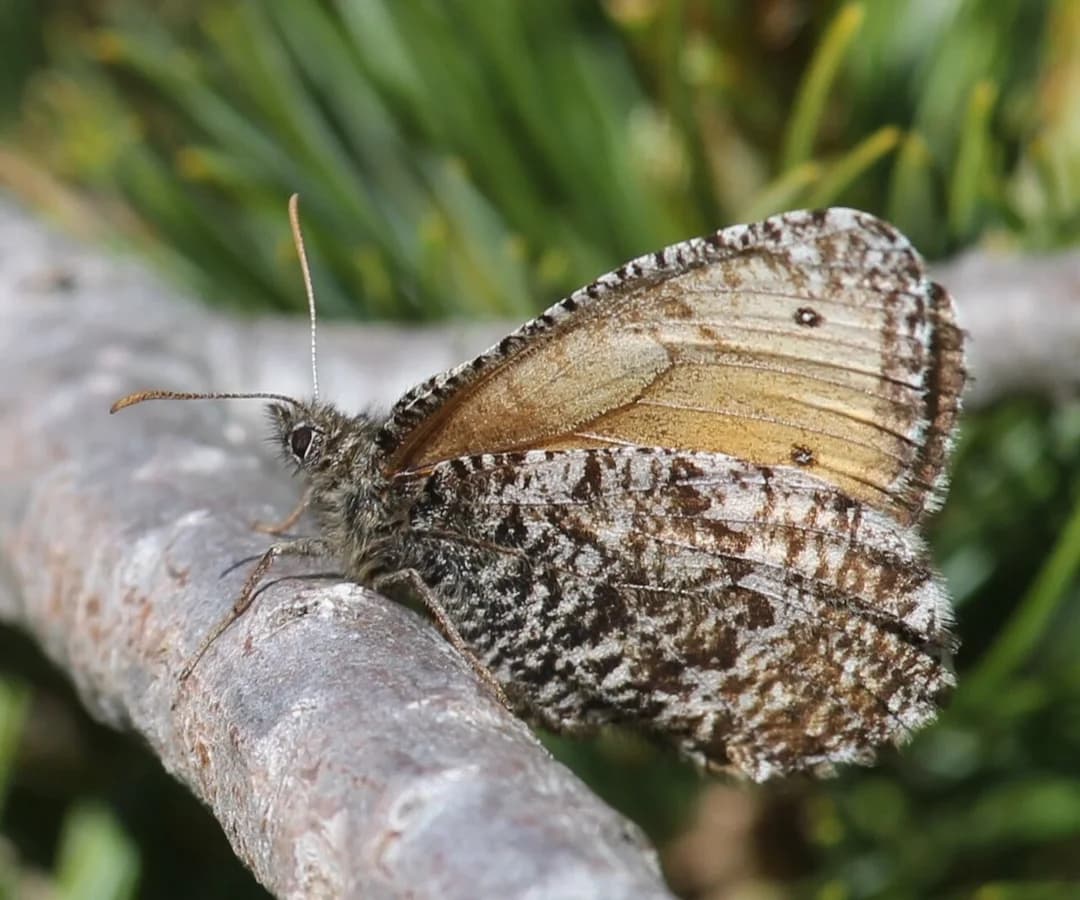
Identifying features
Wingspan 38–58 mm. The male has more pointed forewings and, typically, fewer eye spots than the female, which is larger and more rounded. Typically, 2–3 eye spots are found on the forewing and 1–2 on the hindwing, but the variation ranges from 0–5 and 0–4, respectively. The base colour is normally pale yellowish-brown with broad, dark wing veins forming cross-lines; the variation extends from solid, dark brown to solid ochre-yellow forms. The underside of the hindwing resembles White-veined Arctic, but the dark, spotty vein on the underside is usually absent.
Similar species
The underside of the hindwing resembles White-veined Arctic (Oeneis bore); males are most reliably distinguished by their genitalia. Otherwise, no other similar species have been described in the consulted sources.
Distribution
It occurs locally and relatively commonly from the high-mountain areas Jotunheimen in Norway throughout the mountain range; in Sweden from Härjedalen northward. It is rarely observed in the lowlands down to 66°N. The global distribution includes isolated populations from Fennoscandia and the Kola Peninsula to the Yamal Peninsula, as well as mountainous areas in the Ural, Altai, Sayan, Baikal regions, northern Mongolia, and Japan. Population trends are assessed as Vara stable in Europe.
Biology
Knowledge regarding the developmental stages is limited. Larvae reared in captivity fed on species of Carex with narrow leaves until their first overwintering period; it is likely that the larvae overwinter for the first time as small individuals and a second time as fully grown. Males utilize both patrolling and stationary searching behaviour in their pursuit of unmated females, often selecting dead birch trees as observation points. The butterflies are very elusive and difficult to locate when they have landed, as the underside of the hindwing exhibits excellent camouflage markings. Females live longer than males and visit flowers, but to a lesser extent than other day butterflies in the alpine environment.