
Identifying features
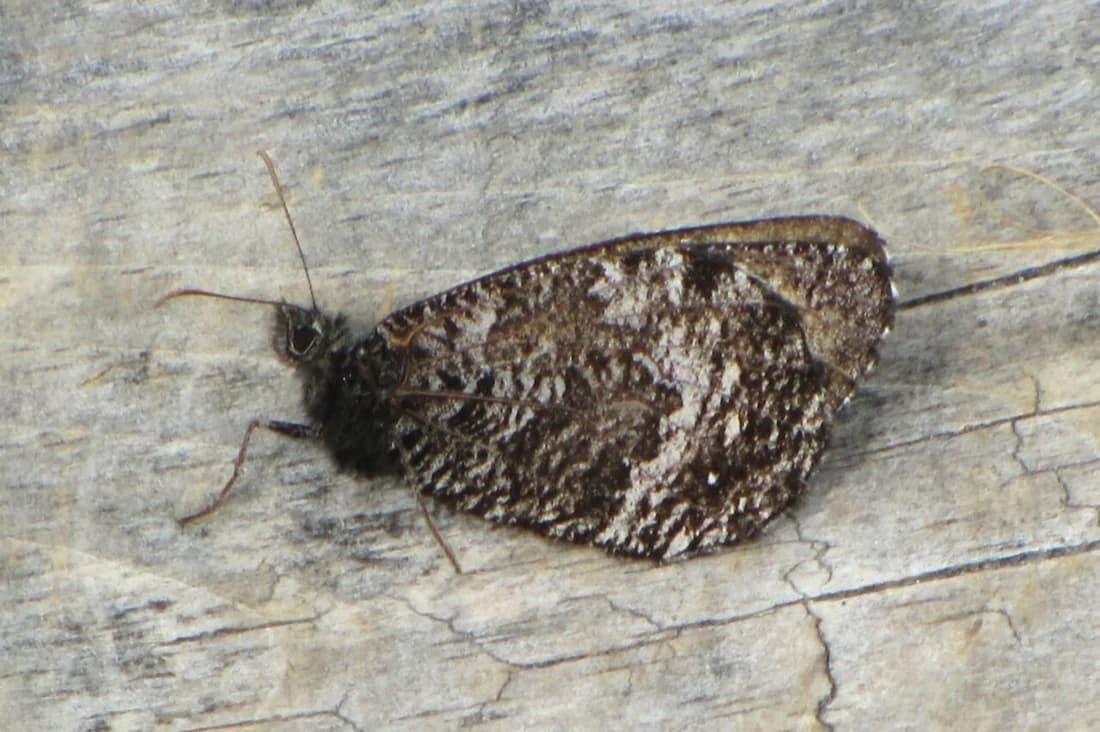
Wingspan 50–58 mm. The male has more pointed forewings than the female, which is more rounded with wider, light-coloured bands. The upper sides of the wings are grey-brown with black and white wing markings. The forewing typically has three eye spots (the number can vary between two and six), and the hindwing typically has four, but they may be completely absent. The eye spots are surrounded by light ochre-coloured spots that extend in the direction of the wing, forming bands. The species differs from the other Oeneis species by the fact that the wing veins on the underside lack a white dusting, and the hindwing lacks a clear rear angle, resulting in a more oval shape.
Similar species
Distinguished from other Oeneis species by the rib markings on the underside of the wings, which lack white dusting and exhibit an oval shape in the hindwings without a clear hind angle. Otherwise, no confusing species are described in the examined sources.
Distribution
Occurs in Sweden from central Southern Sweden, eastern Western Götaland, and up to the pine forest boundary in northern Lapland; local and rare in the southernmost and northern areas, but widespread and fairly common north of Lake Vänern, Lake Hjälmaren, and the Mälardalen region, up to central Northern Sweden. Avoids the coast in the south and is absent from Öland and Gotland. In Norway and Finland, it is widely distributed. The global distribution extends from Fennoscandia and the Baltic through Russia and Siberia to Mongolia, Korea, and Magadan, as well as in North America from Alaska to Colorado.
Biology
South of the Arctic Circle the species occurs only in even-numbered years, clearly showing a two-year life cycle. In Sweden its host plants are cottongrasses; the female lays scattered eggs individually on dwarf birch and small pines above the host plants. The larvae spend their first winter in the 3rd instar, are probably mainly nocturnal and grow very slowly. Males emerge before females and methodically patrol the larger pines at the bog margin in search of newly emerged, unmated females, often spiralling up the trunk.