
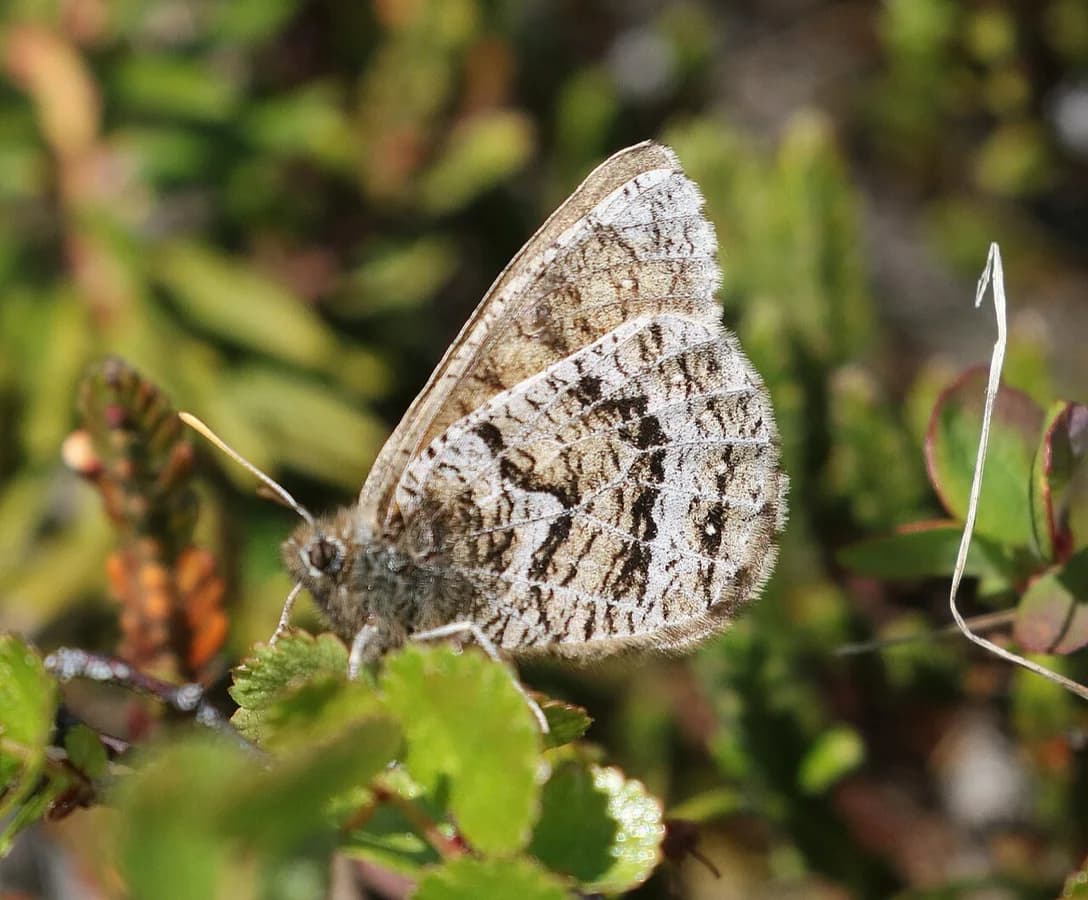
Identifying features
Wingspan 30–50 mm; the forewings are rounder. The upper side of the forewings is almost uniformly coloured in varying shades of grey, usually a greyish-ochre, with no clear cross-bands. The hindwings are more grey, with a lighter grey-yellow cross-band that extends to the outer edge. Eye spots are completely absent – instead, there are only light spots. The underside of the hindwing is mottled with a broad cross-band featuring denser dark mottling, and the wing veins appear as fine white streaks.
Similar species
The males are distinguished from Norse Arctic (Oeneis norna) through their genitalia: White-veined Arctic has a projecting flap on the valves. Otherwise, no confusing species are described in the examined sources.
Distribution
In northern Scandinavia, located on Nordkalotten; in Sweden, only in the northernmost parts – the Tornedal region from the mountains on both sides of the Torne bog, from Pältsan and Tuipal, as well as finds in the fly sand fields of Pulsujärvi. In northern Finland, in lowlands and on dry pine slopes down to 67°N; in Norway, in western and eastern Finnmark. The species’ distribution extends from Fennoscandia and the Bering Sea through Polar Siberia to Beringssund, and further from Alaska to Labrador. The species is listed as strongly threatened in Europe and within the EU.
Biology
The only confirmed host plant is sheep’s fescue. Eggs are probably laid singly and scattered, and take 12–14 days to develop. The larvae grow very slowly and probably overwinter twice: first as small larvae, then buried just beneath the sand between the roots of a sheep’s fescue tussock. After overwintering they pupate in May without a silken shelter; the pupal stage lasts 5–6 weeks. Males patrol and defend territories, often on lower mountain summits during warm summers, a mate-finding behaviour known as hilltopping. Females live longer and visit flowers frequently. The species periodically suffers heavy attacks from parasitoids.