
Identifying features
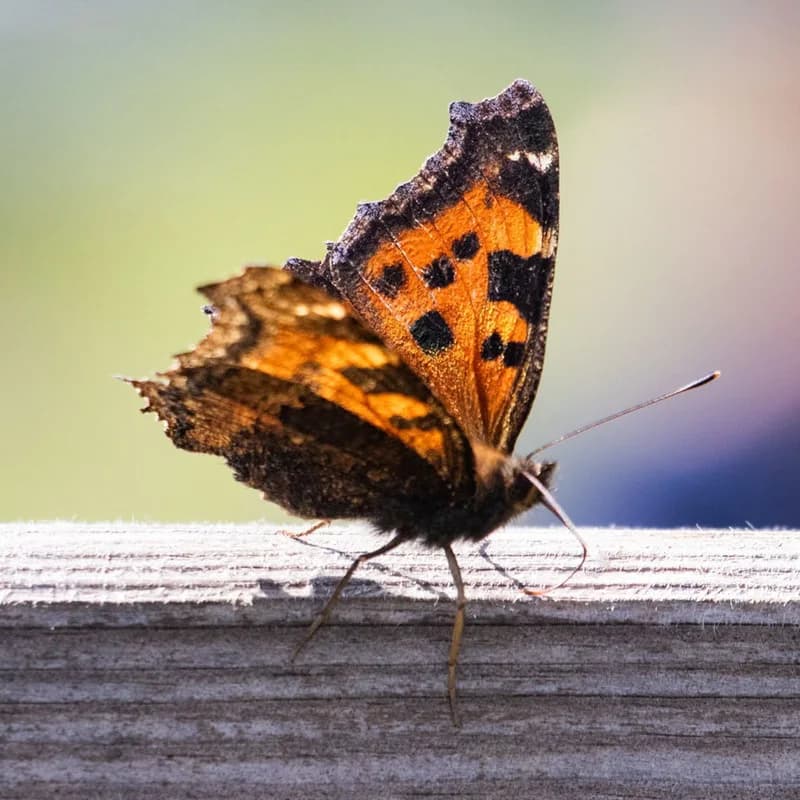
Wingspan 60–71 mm, and the sexes are similar. Very similar to large tortoiseshell, but the dorsal wing colour is slightly redder, and the outer edges of the wings are somewhat more distinctly scalloped. The dark brown marginal band is typically wider and more diffusely defined inwards. Of the three yellowish spots along the leading edge of the forewing in large tortoiseshell, only the outermost spot is clearly visible and more yellowish-white in Yellow-legged tortoiseshell. The most definitive difference is that the mid- and hindlegs have light brown pubescence in Yellow-legged tortoiseshell, while large tortoiseshell has dark brown pubescence. The underside is marbled with brownish tones, featuring fewer black crosslines on the inner half of the hindwing.
Similar species
Very similar to large tortoiseshell (Nymphalis polychloros); the most reliable difference is the light brown pubescence on the middle and hind legs, as well as a wider, more diffuse edge band.
Distribution
First recorded in Sweden in Skåne in 1954; only a temporary presence in the Nordic countries, with a short-lived establishment during the 1950s in north-eastern Skåne and Blekinge. In 2004, it was again observed in Sweden, with sightings in south-eastern Småland and the Oxelösund archipelago. In Denmark, it is present in small numbers, primarily on Bornholm; in Finland, immigration occurs approximately every ten years, with around 50 individuals observed in 2004, and likely reproduction. Not observed in Norway. Areas with more stable annual reproduction extend from Ukraine and Russia, through Siberia and Mongolia, to Nepal, Korea, Japan, and Kamchatka.
Biology
Host plants are primarily various vine species, mainly goat willow and grey vine, but sometimes also elm. The eggs are laid in dense groups during the spring, around thin branches. The larvae’s development is social, similar to large tortoiseshell, with pupation occurring after 4–5 weeks. The species fluctuates very strongly with local and regional mass occurrences with longer time intervals; at such times, it has more temporarily established itself to the west. The butterflies are strongly attracted to sap and can be lured with strings dipped in sweet wine.