
Identifying features
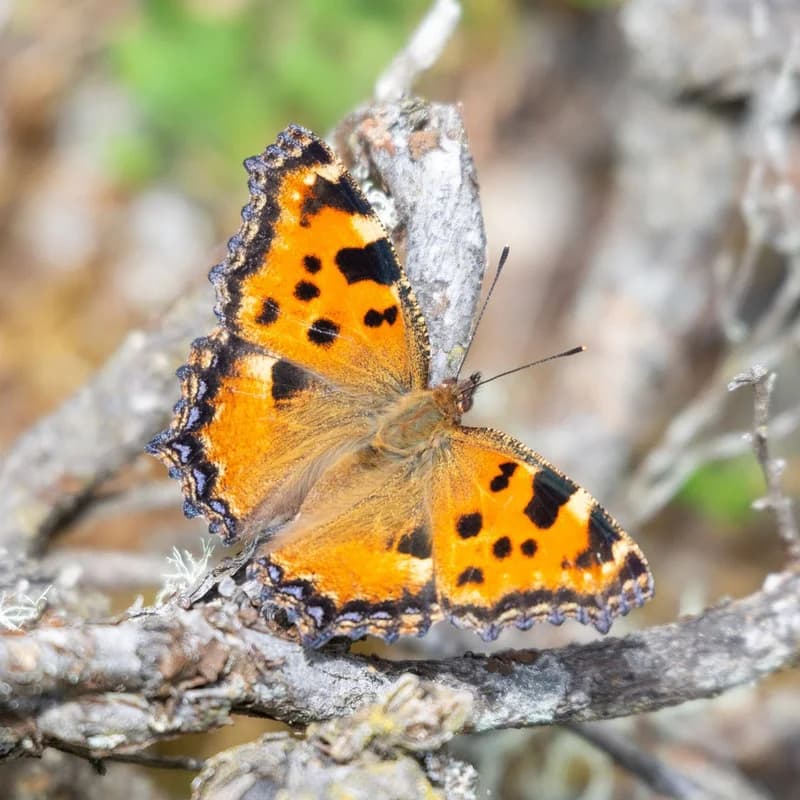
Wingspan 53–69 mm, and the sexes are similar. The upper side of the wings is yellowish-red with large black spots, the largest at the front and rear edges of the forewings, and broad black-brown borders, which on the hindwings have blue margins. The colour is slightly more brownish than in Small Tortoiseshell. The undersides are finely mottled in brown, grey, and at the edges, bluish shades with a few distinct black lines.
Similar species
Very similar to Yellow-legged tortoiseshell (Nymphalis xanthomelas), which, however, usually has wider black borders with a more diffuse boundary against the reddish-yellow colour, as well as lighter yellowish-brown colouration on the legs (darkish in large tortoiseshell). After overwintering, bleached individuals in the field may possibly be mistaken for a swallowtail butterfly.
Distribution
Known from almost the entire southern and central Sweden region up to northern Vänern and Mälardalen; its main distribution area encompassed coastal areas. Following rainy summers at the beginning of the 1960s, it was only found annually in the central part of Öland, from which it gradually spread north along the eastern coast, as well as along the southern and western coasts. In Norway, it was sporadic; in Finland, a temporary immigrant. Its global distribution extends from North Africa and Norden eastward through the Mediterranean region and southern Russia to north-western Kazakhstan, as well as isolated in the Himalayas.
Biology
The main host plants are wych elm, goat willow, grey willow, aspen, sweet cherry and pear. The female lays 20–200 eggs together in a ring around the terminal shoots of deciduous trees in sunny locations. The larvae live together until the final instar; larval development takes 30–50 days. Fully grown larvae drop to the ground and pupate hanging from at least two metres above it; the pupal stage lasts 2–3 weeks. Before overwintering the butterflies never visit flowers and are found mainly at freshly leaking tree sap. After overwintering they visit willow and fruit-tree blossom. The species is sensitive to rainy summers, and populations fluctuate markedly.