
Identifying features
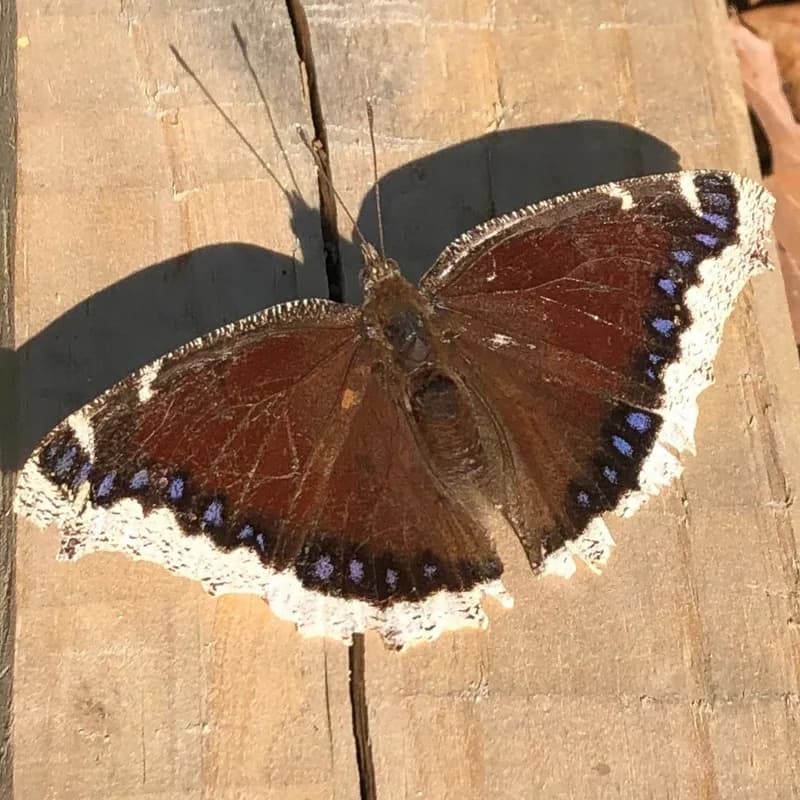
Wingspan 61–76 mm, and the sexes are similar. The upper side of the wings is dark reddish-brown with broad yellow borders that are inwardly outlined by shining blue spots; at the front edge of the forewing, there are two lighter yellow or white spots. In overwintering individuals, the colour appears almost black with a pale yellow border. The underside is brownish-black and speckled with a broad pale yellow border.
Similar species
No similar species are described in the sources consulted.
Distribution
Found in all Swedish landscapes and in most of the provinces of the neighbouring Nordic countries. Favoured by an Atlantic winter climate, it is therefore normally rare or temporary in Denmark, western Norway, the Faroe Islands, and Iceland. The global distribution extends from Europe through Turkey, the Caucasus, and Siberia, to the Himalayas, Japan, and Kamchatka, as well as in America from Alaska to Venezuela.
Biology
The main host plants are birch and goat willow; larvae have also been found on aspen and other willows. In spring the female lays up to 250 eggs together in a ring around slender twigs. The larvae live together until the final instar, and development takes 6–7 weeks. Pupation takes place on stones, twigs and herbs near the ground; the pupal stage lasts 2–3 weeks. The butterflies rarely visit flowers but frequently visit trees with leaking sap. They overwinter in woodpiles, uprooted root plates and fallen trunks, and become sexually mature only in spring. Populations usually contain few individuals and have fluctuated markedly over the years, probably due to the weather.