
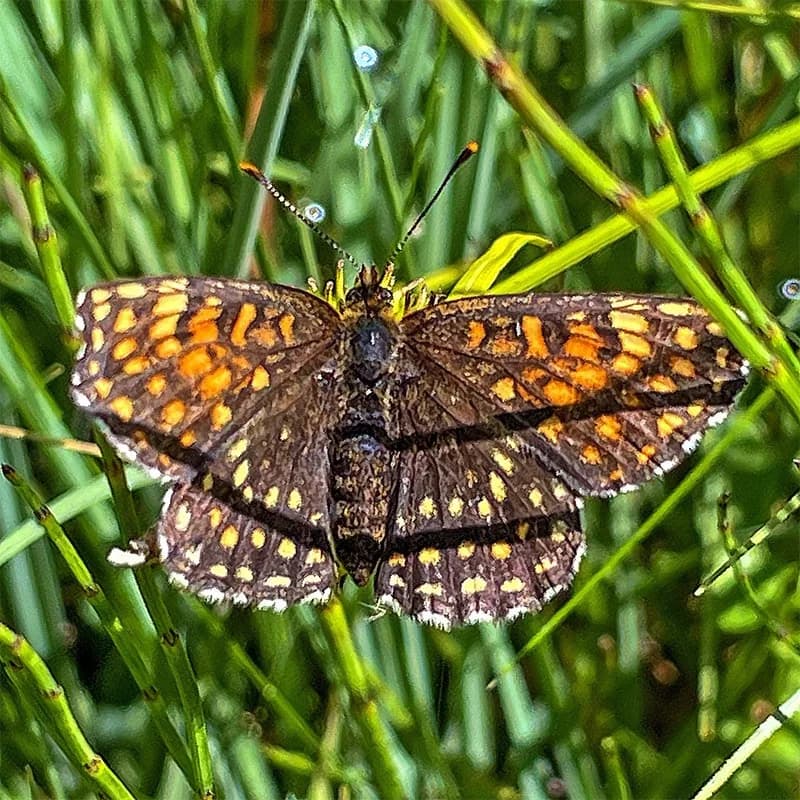
Identifying features
Wingspan 36–42 mm; the female is slightly larger and often has paler spots on the outer side. The upper sides of the wings are velvet black with brown tones and small light spots that do not form any net pattern; the male’s spots are uniformly reddish-brown, while the female’s are more brownish-yellow. The safest identifying characteristics are found on the underside of the hind wings: the brown cross-band in the outer field is more strongly shaded at the inner edge, and the cells of the band have a black spot surrounded by a light halo. The eye spot is sulphur yellow.
Similar species
Can be confused with certain forms of heath fritillary (Melitaea athalia) and the veronica web butterfly (M. britomartis). However, the veronica web butterfly is likely absent from Sweden.
Distribution
Previously occurred in large parts of southern and central Sweden, up to central Norrland; it has now disappeared from several regions, and the number of locations has decreased significantly. In Norway in eastern Sörlandet and southernmost Östlandet, and inland in some fjords. In Denmark, it was extinct but has been reintroduced with individuals from Skåne. The global distribution is divided into many isolated regions from Europe through Siberia to Japan and Korea.
Biology
Connected firmly to Scandinavia, focusing on specific root species: on the mainland, primarily the birdcherry root, and on Öland, the small root. The female lays approximately 100 eggs in a regular layer on the underside of sun-exposed leaves. Newly hatched larvae live relatively unprotected on the underside of the leaves; later, they spin a spun web. After 3–4 weeks, the larvae in the 3rd–4th instar stage prepare for overwintering by rolling up dry leaves. After overwintering, the larvae live solitarily. In Bergslagen, half of a brood of larvae returns to a period of dormancy and emerges as butterflies the following summer. Pupation occurs low in herb vegetation; the butterflies emerge after 2–3 weeks.