
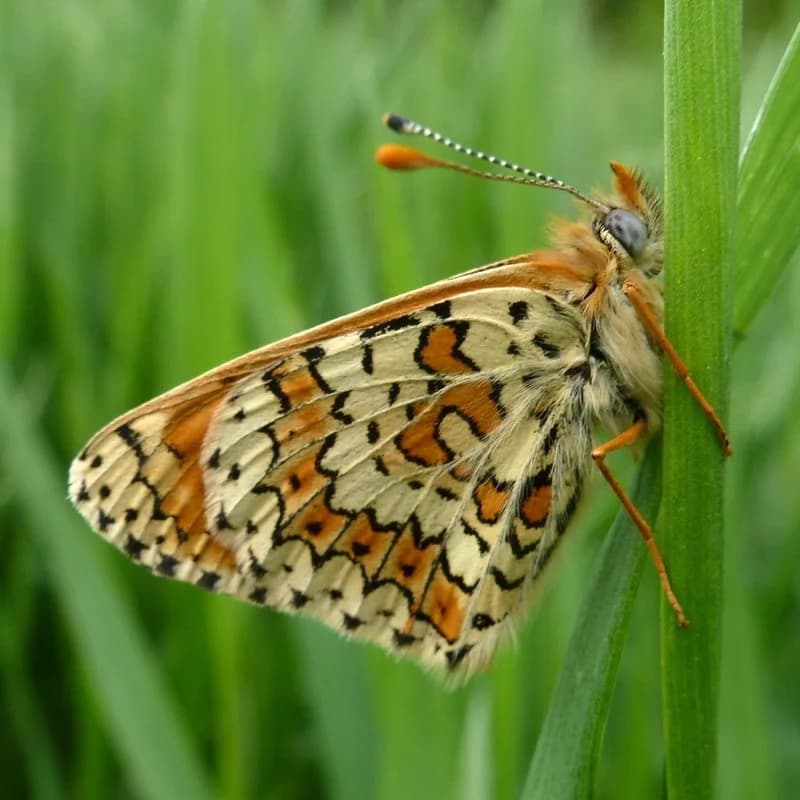
Identifying features
Wingspan 37–46 mm; The Gotland subspecies, winbladi, is significantly smaller (male approximately 33 mm, female 35–39 mm). The upper side of the wings is dark brown with three broad, brown-yellow bands. The broadest brown-yellow bands on the hindwings almost always have a black spot in the center of each cell – one of the best recognition marks in the field. The underside of the hindwing is pale yellow with a distinct, black-edged, brown-yellow outer band with a black spot in each cell.
Similar species
No similar species are described in the sources consulted.
Distribution
It has steadily decreased in line with the recovery of marginal cultivation areas. Outside of Öland and Gotland, where it is still widespread and locally abundant, it is only found very locally: in Skåne in sandlands and sandy areas, in Östergötland and along Vättern, on the west coast in Gothenburg’s archipelago, and on the coast from Östergötland to Uppland. In Finland, it has been carefully studied on Åland (approximately 400 occurrence areas). The global distribution extends from North Africa and Scandinavia through Europe and Siberia to Mongolia, western China, and Jakutien.
Biology
Host plants are yellow or black snakeroot, black snakeroot, and, during dry periods, yellow snakeroot. The female lays 100–200 eggs in groups on leaf undersides. The larvae live socially in silken webs, grow for up to two months, and overwinter in the 4th–5th instar. Pupation occurs low in dry grass; the pupal stage lasts 2–4 weeks. The larvae are attacked by the tussock moth, Cotesia melitaearum. Extensive studies on Åland have shown that the species is dependent on a metapopulation dynamic: the occurrence areas are small and scattered, and must be located sufficiently close together so that individuals can migrate between them and counteract inbreeding.