
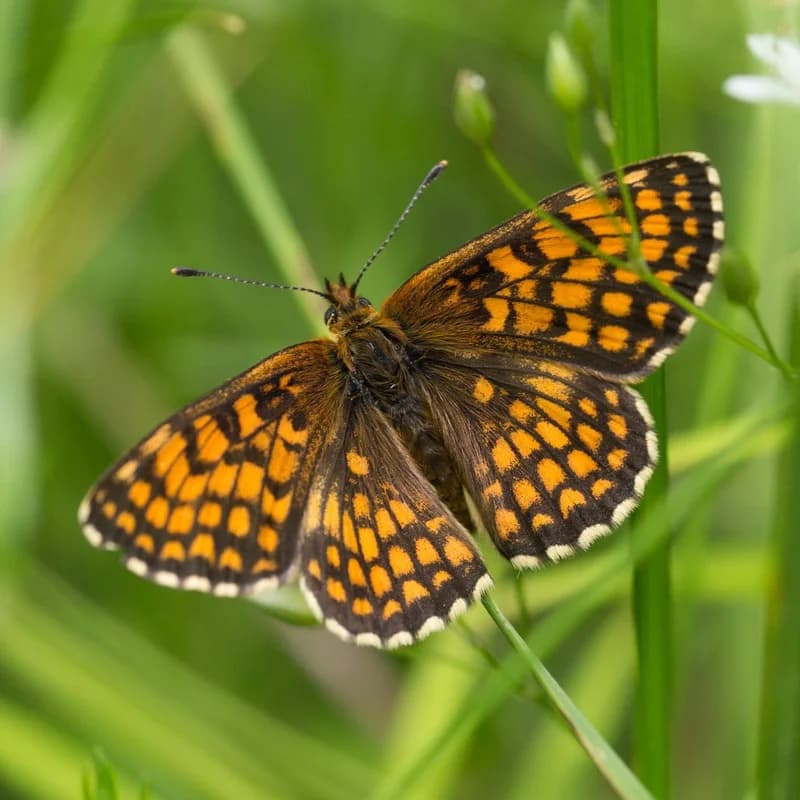
Identifying features
Wingspan 32–42 mm for the most widespread subspecies, lachares; the norvegica subspecies is smaller (29–33 mm). The upper side of the wings is dark brown with three brown-yellow transverse bands of spots outside the disc field. The most reliable characteristics for species identification are found on the underside of the hindwing: it is usually a pale straw colour with a brown-red transverse band with a distinct black border, but the band lacks strong shading inwards, and the black spots in the cells, which are always present with false heath fritillary.
Similar species
Can be confused with dark individuals of false heath fritillary (Melitaea diamina) and with the Veronia fritillary (M. britomartis). The safest characteristics are found on the underside of the hindwing, as described above.
Distribution
Occurs throughout Northern Europe from southern Jutland and Scania to the interior of Porsangerfjord and Sør-Varanger in Northern Norway, but avoids the Atlantic coast. The subspecies norvegica lives along the entire mountain range to Finnmark. The worldwide distribution extends from Spain, southern England, and Northern Europe through Europe and Siberia to Jakutien, Korea, and northern China.
Biology
The female lays 30–70 eggs in irregular clusters on various species, including Veronica species in southern areas, as well as Veronica nigra. Newly hatched larvae spin a small cocoon, but later become solitary; they overwinter in the 3rd–4th instar. In the subspecies lachares, 75% of the larvae develop into butterflies in the same year, while the rest enter diapause, resulting in a life cycle of 2–3 years. The pupal stage lasts 2–3 weeks. The males patrol to find newly emerged females.