
Identifying features
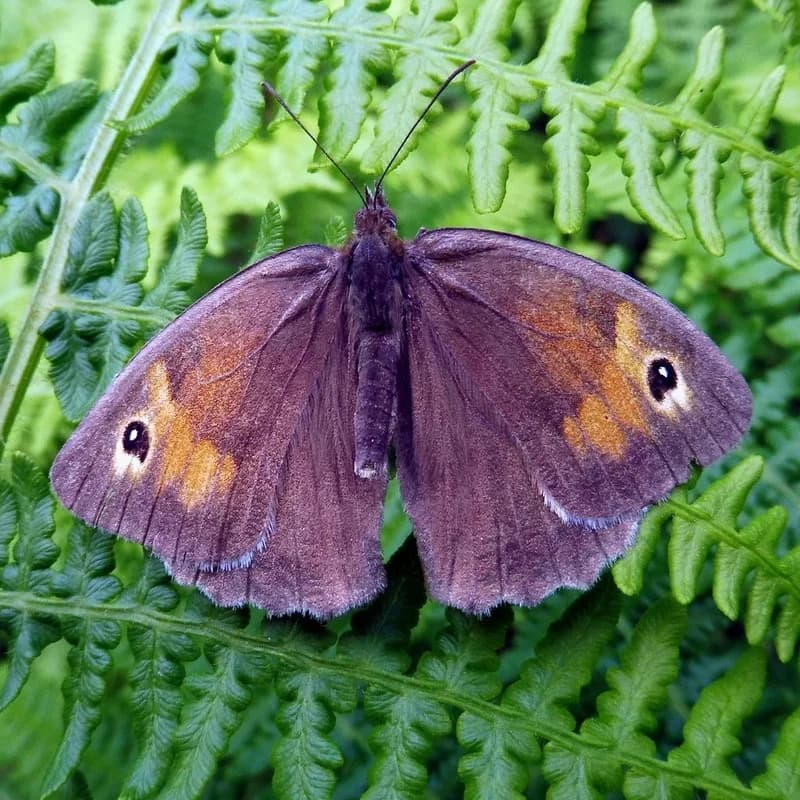
Wingspan 36–49 mm. The upper side of the wings is dark brown. The forewing has a black, yellow-ringed eye spot with a white center; in females, the eye spot is surrounded by a wider, red-yellow transverse band. The hindwing may have a suggestion of a red-yellow transverse band in females. The underside is light brown with a broad, diffuse grey-yellow or grey-white transverse band on the hindwing. The upper side of the male wings has a slight blue or greenish shimmer in certain lighting.
Similar species
No similar species are described in the sources consulted.
Distribution
Climate-sensitive with a shifting northern limit: currently the furthest north to northern Uppland along the coast and inland to southern Värmland, Östergötland, and eastern Södermanland. During the 1930s and 40s, it was generally found inland in Dalarna and Hälsingland, and along the coast to Ångermanland; since the 1960s, it has been in retreat. In Denmark, it is widespread and common; in Norway, it is only found in southern coastal areas. Its global distribution extends from Great Britain, the Canary Islands, and North Africa, through Europe, to Southern Asia, Iran, and southern Ural.
Biology
The eggs are laid scattered on the stems and leaves of a large number of grass and clover species, including sweetgrass, red clover, thyme, wavyhair clover, spring meadowgrass, and meadow sedge. Larval development is slow, and the larva overwinters in the 2nd–4th stage; pupation occurs hanging from a grass blade in June, and the pupal stage lasts 2–4 weeks. The species has only one generation per year throughout Europe. Both sexes are active flower visitors, and the males search for females by patrolling areas where they are expected to emerge.