
Identifying features
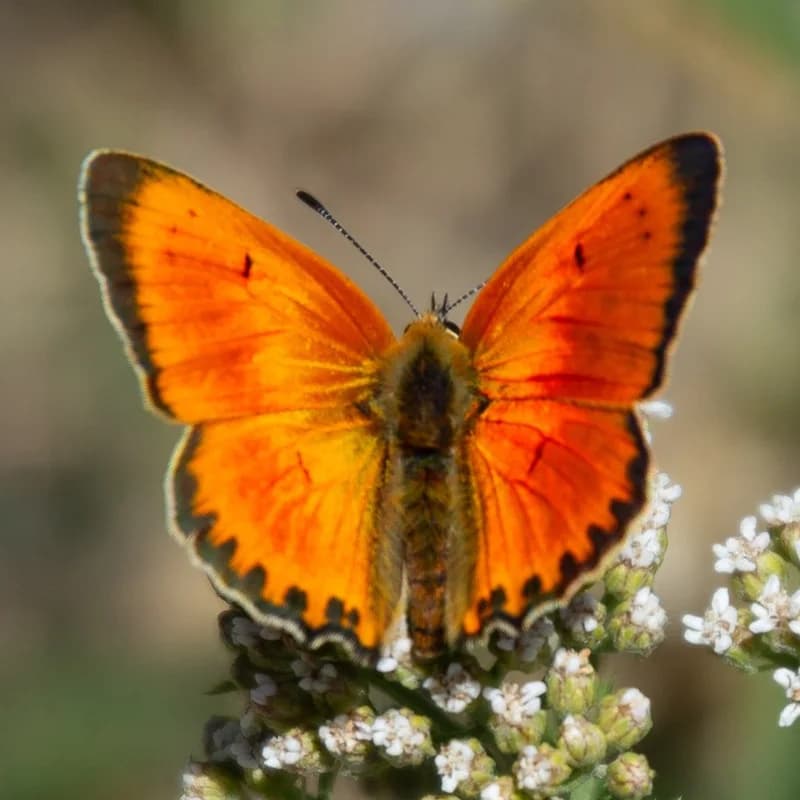
Wingspan 26–32 mm. The male’s upper side is gold-shimmering yellowish-red with a narrow black border. The female is often lighter yellowish-red with two spots in the scales, and transverse bands of darker spots. The best recognition features are found on the underside of the hindwing, which is grey-yellow to brown-yellow with a transverse band of small white spots resembling comet’s tails from a few small black spots.
Similar species
No similar species are described in the sources consulted.
Distribution
Widespread throughout southern and central Sweden; from Jämtland to Norrbotten, the subspecies oranula occurs, and in the forests of Pite and Lule Lappmarkers, the subspecies punctatus is found. It is present throughout Finland, except in the Lappmarkers, in southern Norway to Nord-Tröndelag and across a large part of Denmark. Its global distribution extends from Europe through Turkey, the Middle East, and the Caucasus to Siberia, Mongolia, and Yakutia.
Biology
The growth occurs primarily with common sorrel (Rumex acetosa); the eggs are laid one at a time on the stems, leaf stalks, and leaves. The species overwinters in the egg stage, and the larvae hatch in the spring. Growth takes approximately seven weeks, and the pupal stage lasts for 2–3 weeks; the pupa attaches with a strap-like thread on above-ground plant stems. The males patrol in search of unmated females. The species has only one generation per season throughout Europe.