
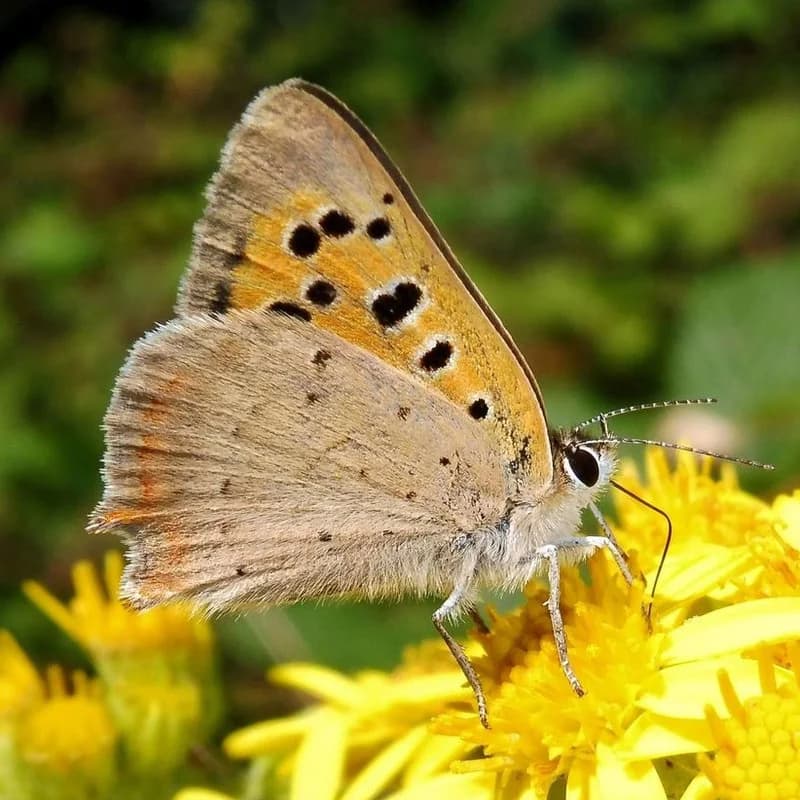
Identifying features
Wingspan 22–34 mm. The sexes are similar. The upperside of the forewing is coppery-red with a broad black marginal band, six black spots in a transverse row, and two black spots in the disc area. The upperside of the hindwing is dark grey with a wavy red marginal band, and occasionally a row of small blue spots just inside it. The underside of the hindwing is brownish-grey with indistinct black spots.
Similar species
No similar species are described in the sources consulted.
Distribution
Occurs throughout Northern Europe but is most common in the southern half; does not extend beyond the tree line in the mountains. Distributed along the Atlantic coast from Norway to Lofoten. Its global distribution is extensive: from North Africa and Ireland through Europe, the Middle East, Central Asia, and Siberia to China and Japan, as far south as Kenya and Nepal; the subspecies polar is also found in Alaska, northern Canada, and northern Greenland.
Biology
The host plants are primarily sheep's sorrel (Rumex acetosella) and common sorrel. The eggs are laid one by one on the leaves; larval development is rapid during the summer, and overwintering occurs as a nearly grown larva. The males use both patrolling and territory defence from vantage points. The butterflies often rest on the ground or rocks with their wings open at an angle of 45 degrees and prefer to use common overnighting spots.