
Identifying features
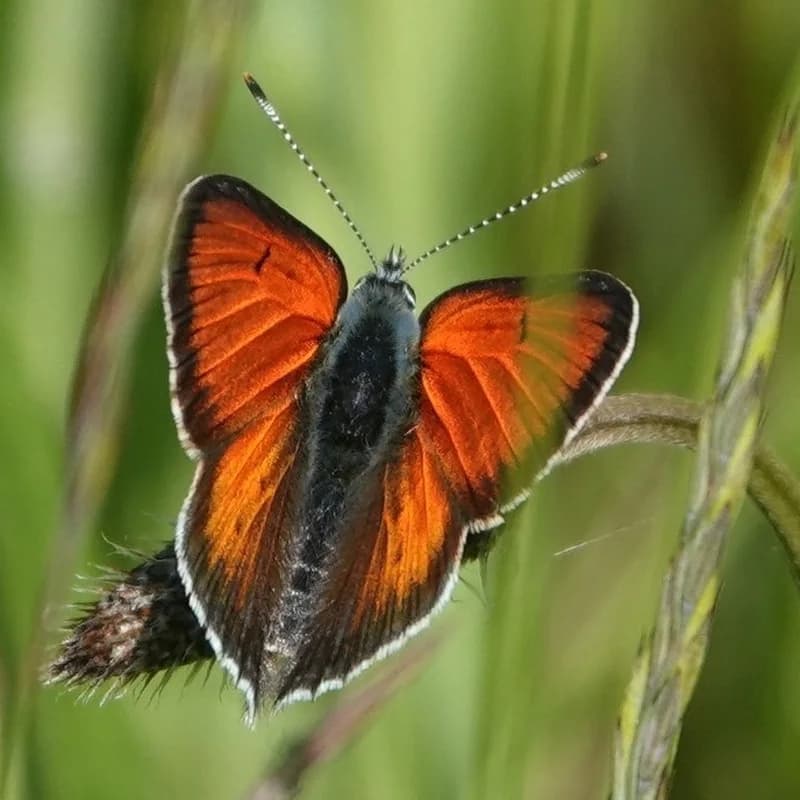
Wingspan 30–35 mm. The male is gleaming yellowish-red on the upper side, with black margins and violet-shimmering pigment along the front edge of the forewing and on the lower edge of the hindwing. The female is dark brown on the forewings, with more or less spread yellow-red pigment, black spots, and two transverse bands of black spots, the inner row evenly curved. The underside is yellowish-grey with clearly light-edged black spots.
Similar species
The female may be confused with scarce copper (Lycaena virgaureae), violet copper (L. helle) or small copper (Lycaena phlaeas). The most similar species, purple-shot copper and sooty copper, have not yet been recorded in Sweden.
Distribution
Widespread throughout Sweden, but significantly decreasing in the south since the 1980s. Found throughout Norway across the country to Finnmark; formerly widespread in Denmark and Finland, but now decreasing significantly in those areas. The global distribution extends through central, northern, and eastern Europe to Siberia, Altaj, Mongolia, and the Amu area.
Biology
The most important plant growth is common sorrel (Rumex acetosa). Eggs are laid one or two per leaf and hatch after 1–2 weeks. The slow larva prepares for overwintering in the third stage and undergoes pupation the following spring near the ground surface. The males patrol rapidly in search of females. Both sexes are active flower visitors.