
Identifying features
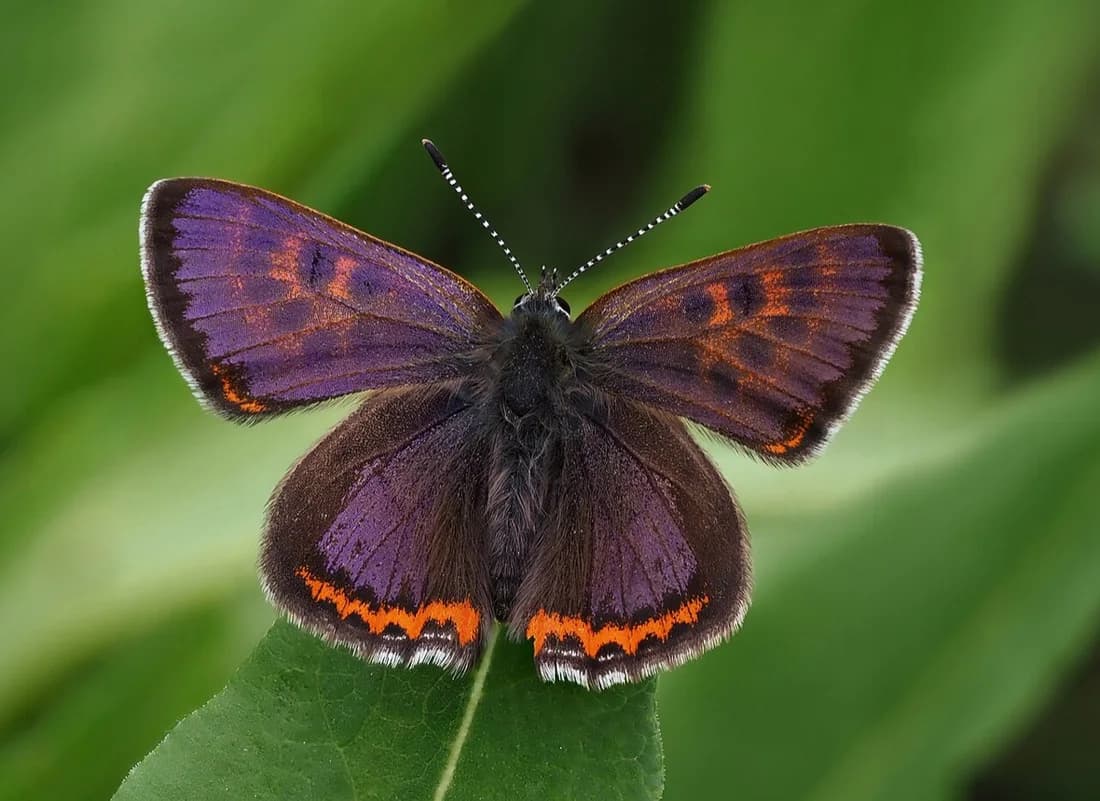
Wingspan 22–26 mm. The male’s forewings are violet on the upper side, with a narrow, dark brown band and elongated black spots; the hindwings are predominantly dark brown with a violet shimmer and a yellow-red edged band. The female is predominantly dark brown with transverse bands of black spots. The underside is grey-yellow with two distinct transverse bands of black spots and a clear yellow-red edged band.
Similar species
Can potentially be confused with purple-edged copper (Lycaena hippothoe) or small copper (Lycaena phlaeas).
Distribution
Previously, from northern Västerbotten and northern Uppland, to the Torne area; since the sun-poor summer of 1987, it is certainly only found in a few areas from northern Dalarna and Gästrikland, somewhat more abundant in central Sweden. It is also found east of the mountain range in Norway and in parts of Finland. Its global distribution extends from Europe and the Caucasus, through Siberia, to Mongolia, Trans-Baikalia, Yakutia, and the Amur region.
Biology
The host plant is Bistorta vivipara, a low-growing, sun-loving plant that is quickly displaced if the roots are disturbed. The eggs are laid one at a time on the underside of the leaves and hatch after approximately ten days. The larvae are sluggish and attract only a small number of ants. In Sweden, the larvae undergo pupation, buried in moss, and the species overwinters in the pupal stage. The species is covered by the EU’s Habitats Directive and has an action program.